

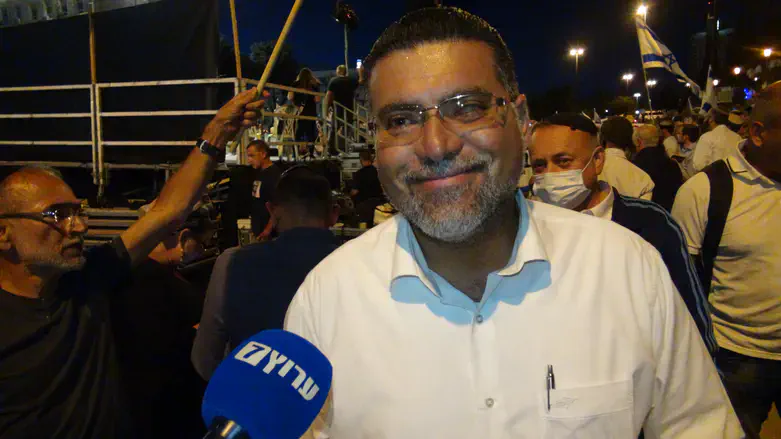
Israeli Arab educator and public diplomacy advocate Nahil Zoabi believes there is growing support for the establishment of a pro-Israel Arab political party that identifies with Israel's values and character as a Jewish state.
Speaking in an interview with Arutz Sheva, Zoabi argued that the majority of Israel's Arab sector holds views that are rarely heard.
"The voice of the majority of the Arab sector in Israel is a quiet voice," he said. "It wants to integrate and connect, but what prevents that are the Arab parties, which have a well-oiled political machine and extensive resources. They are visible everywhere."
According to Zoabi, there is a desire within Arab society for "an Arab party that speaks about active citizenship for Israel's Arab citizens, one that focuses on what truly matters to Arab society in Israel-cost of living, education, healthcare, transportation, employment, and higher education. That is what will attract the Arab voter."
Zoabi noted that roughly half of Israel's Arab electorate does not vote at all.
"I see that as a clear statement of distrust in the Arab parties," he said. "Those parties thrive on the tension between the Jewish and Arab sectors and on the tension between the Arab sector and the state."
Establishing such a party, Zoabi said, would require "a great deal of logistics, funding, organization, and strength to compete with movements that have existed since before the establishment of the state. These parties have student organizations, women's organizations, and local branches in villages and cities."
In Zoabi's view, the average Arab citizen, if asked about his personal aspirations, would speak about earning a living, housing, healthcare, and education-not about opposing the state or its institutions.
"But when Election Day arrives and the political campaign begins, they have only one product available, so that's what they end up buying," he said.
Zoabi also recalled that until the 1980s there was the United Arab Party, which he described as "proud Muslims who proudly raised the flag of the State of Israel."
"It was a satellite party of the Labor Party. No one imagined Labor would collapse and fall apart. When that happened, the satellite party collapsed as well," he said.
Zoabi believes that anyone with the means to establish a new party along similar lines would face enormous pressure to abandon the idea.
As for himself, he said that since the October 7 attacks he has devoted himself exclusively to Israeli public diplomacy on numerous Arab-language media platforms that are hostile to Israel. To date, he said, he has given more than 800 interviews.
He explained that he has deliberately chosen not to become involved in internal party politics, instead focusing solely on presenting Israel's case to Arab audiences.
However, when asked whether he might eventually enter politics himself and establish a pro-Zionist Arab party, Zoabi did not dismiss the possibility.
"I do not rule out entering politics," he said. "I see it as something sacred, and anyone who does it must have a profound belief in bringing the different sectors of society closer together and in bringing the Arab sector closer to the government. We need to work to build an Arab-Israeli citizen who is proud of that identity and who is educated according to Arab-Israeli civic values."