

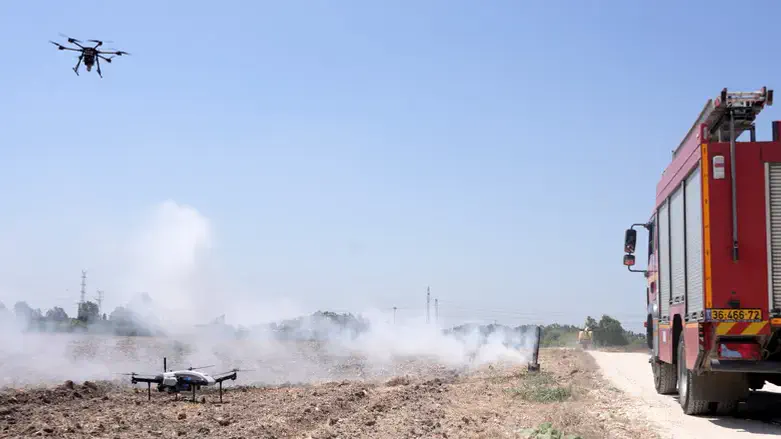
Israel has successfully completed the first test of a new drone-based system designed to detect wildfires within minutes of ignition, enabling emergency crews to respond before flames spread.
The project is a joint initiative involving the National Security Ministry, the Innovation Authority, the Technion, the Israel Fire and Rescue Authority, and Israel Aerospace Industries (IAI). During the initial test flight on Wednesday, the system successfully identified and located simulated fires. Additional trials are now underway to evaluate its performance in different operational environments and terrain.
The technology is built around IAI's APUS 25 tactical drone, which features vertical takeoff and landing (VTOL) capabilities, allowing it to operate without a runway. Equipped with day and night cameras and infrared sensors, the drone can detect heat sources through heavy smoke. Artificial intelligence and advanced spectral algorithms analyze the imagery in real time, pinpointing the fire's location within a few meters and automatically alerting Fire and Rescue command centers.
Unlike battery-powered drones, the APUS 25 uses an internal combustion engine, enabling continuous flights of up to five hours. Firefighters simply designate the search area on a digital map before the drone autonomously carries out its surveillance mission.
Yaron Shein, head of technological R&D at the Office of the Chief Scientist in the National Security Ministry, said the project marks "another step in promoting advanced technological capabilities for security and emergency organizations." He said integrating drones, artificial intelligence and advanced data processing could enable earlier fire detection, improve situational awareness and shorten emergency response times while helping protect lives, property and Israel's natural resources.
Moshe Levi, director of IAI's Military Aircraft Division, said the project demonstrates how expertise in aviation, artificial intelligence and autonomous systems can be applied to address both national and international challenges. He said partnerships of this kind turn advanced technology into practical operational capabilities with real-world value.
Keren Nevo, deputy CEO of the Growth Division at the Innovation Authority, said the initiative showcases how testing advanced technologies in real operational environments can generate tangible public benefits. She said the combination of drones, artificial intelligence and terrain-adapted operations provides an innovative solution to urgent firefighting challenges.