

The United Nations Security Council voted Tuesday to extend for another six months a mandate requiring the Secretary-General to monitor and report on ongoing Houthi strikes against commercial shipping in the Red Sea.
The measure, co-sponsored by the United States and Greece, passed with 13 votes in favor, while Russia and China abstained. The renewed mandate ensures monthly UN monitoring will remain active through Jan. 15, 2027.
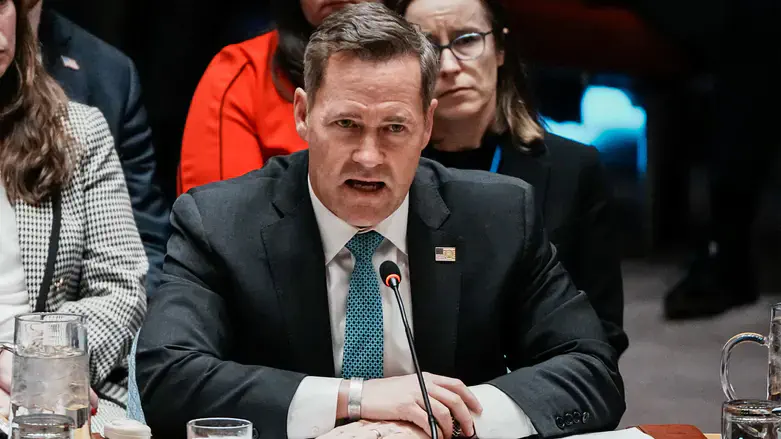
Addressing the chamber following the vote, US Representative to the UN Ambassador Mike Waltz welcomed the technical rollover but warned that monitoring alone is insufficient to stop the Iran-backed group from threatening global maritime corridors.
“The United States welcomes the technical rollover of this resolution for another six months, and we particularly want to thank Greece for their partnership," Waltz said. “Colleagues, Iran’s attacks on commercial vessels and its attempt to hold the Strait of Hormuz - and with it the world economy - hostage have made two things clear. Number one: freedom of navigation is essential to international peace and prosperity, as this Council has discussed extensively in recent months; and two, there are regimes willing to trample that freedom to score political points, to try to win an argument, or to shield themselves from the consequences of their own aggression."
Waltz noted the direct links between the Yemeni group to Tehran, characterizing the Houthis as regional proxies following an established Iranian strategy.
“Colleagues, this is what is crystal clear today: That the Houthis, a declared terrorist organization, are Tehran’s acolytes. They have studied the IRGC playbook," he stated. “And here’s what happens: When Iran kidnaps civilians, the Houthis do too. When Iran hides behind human shields, the Houthis do as well. When Iran targets civilian infrastructure across the Gulf, so do the Houthis."
Highlighting the group's rhetoric, the US envoy pointed to anti-Western slogans featured on official Houthi flags.
“When Iran chants ‘Death to Israel’ and ‘Death to America,’ the Houthis repeat it word for word. In fact, look at the Houthi flag. It essentially says those two things: ‘Death to Israel’ and ‘Death to America.’ On their flag," Waltz stated. “And, then they actually add their own twist, chanting ‘Death to America, Death to Israel,’ and then they add, ‘A Curse Upon the Jews.’ This is from the Houthis, repeatedly and on the record."
“So, if Iran is willing to threaten the Strait of Hormuz, how long before the Houthis decide, to once again mirror their benefactor, their mentors, their idols in Tehran, and try to shut down the Red Sea? They’ve already threatened to do it," he added.
Waltz cited this week’s escalation targeting civilian infrastructure in Saudi Arabia as further evidence of Houthi destabilization.
“And just yesterday, the Houthis launched missiles and drones at Saudi Arabia’s civilian - and I emphasize, civilian - Abha International Airport, and threatened civilian airlines while they’re in the air in Saudi airspace," Waltz said. “The Houthis are not defending Yemen, as they claim, by threatening civilian families - men, women, and children - flying aboard civilian aircraft. They are not making the case for a stable Yemen by striking airports that in the past conducted commerce and travel between Yemen and Saudi Arabia. No, they are terrorizing the region on Tehran’s behalf. End of story."
He underscored that the Houthis have asserted unilateral authority over international shipping lanes through force.
“The Houthis have also launched missiles towards Israel and have declared that they will dictate which nations navigate the Red Sea and which may not. Their first ban? Israeli ships - civilian, military, doesn’t matter - according to the Houthis, they're decided what’s allowed," Waltz declared. “And the Houthis seem to believe that a missile launcher gives them jurisdiction over the world’s most important waterways. And colleagues, as you have heard from the United States repeatedly, that is something we as an international body cannot allow. Those with the missile launcher do not decide what’s international waters and what is not. Those with sea mines do not get to decide how we as free and sovereign nations conduct international trade. They do not get to decide which flags may sail, which families may fly, safely and freely, or which economies may trade."
The ambassador argued that past Security Council resolutions, including Resolution 2722, have failed to deter Houthi operations because the council has hesitated to enforce real consequences.
“The Houthis have repeatedly tested whether this Council’s resolutions mean much. Resolution 2722 demanded that the Houthis immediately cease their attacks against merchant and commercial vessels in the Red Sea. And once again the Houthis have not complied," Waltz noted. “Colleagues, every time this Council responds to terrorism without consequences, the terrorists learn the same lesson: keep it up, keep firing, there will be no consequences."
“You know President Trump’s preference, I’ve stated it here, my preference, the United States’s preference. We say it all the time: Our preference is always to use words, and not bullets," he continued. “But diplomacy only works when our words mean something. And every time the Houthis fire another missile after this Council tells them to stop, they are betting that our words are empty. They are hedging that another Secretary-General’s report won’t mean very much to us - won’t cause consequences for them."
“And so, we welcome this Resolution’s continued vigilance in calling out the Houthi threat. But, Colleagues, I’m convinced this reporting mechanism cannot and should not become just another United Nations paper exercise," Waltz added.
Calling on UN member states to actively interdict illegal supply lines, Waltz referenced a recent UN Panel of Experts report addressing dual-use goods flowing to Yemen.
“Colleagues, just one additional point in this regard: We welcome the UN Panel of Experts’ June 30th report on dual-use items and urge Member States to act on its recommendations," he stated. “This is something that is actionable, that is reasonable, that is within capabilities to interdict and to take action on these dual-use items. Let’s not file this report away until the Houthis launch the next missile."
“This Council’s Resolution 2216 imposed an arms embargo prohibiting the supply, sale, or transfer of weapons to the Houthis. That prohibition includes - and this is the important point - the prohibition includes the components, the technology, and the dual-use items that feed Houthi missile, drone, and surveillance programs," Waltz said. “So, we’re calling on our colleagues here, we’re calling on like-minded nations, to take meaningful action in their own regard to intercept and to interdict these dual-use items and to enforce this Council’s resolution. States like Iran, and to some degree companies and entities in China, have violated Resolution 2216 with little consequence."
To illustrate ongoing violations of the UN arms embargo, Waltz pointed to a recent flight between Tehran and Yemen.
“Just this week, an Iranian aircraft carried a Houthi delegation from Tehran. Yemen’s UN-recognized government says Iran used the flight to transport equipment and experts to the Houthis under the cover of a funeral delegation," he said. “And if you haven’t seen it, watch the video of that flight. It’s openly available. When the plane enters Yemeni airspace, the Houthis and Iranians onboard the plane, chant: ‘Death to America, Death to Israel, and A Curse Upon the Jews.’"
“That’s the trade, and that’s what’s happening in plain sight in front of all of us: Tehran provides the planes, the personnel, the technology, and the weapons. And the Houthis provide the launch site and instability," Waltz concluded. “And this Council should never allow commercial shipping to become a hostage negotiation with terrorists. And the Houthis must put down their weapons. Iran must stop supplying them. And every Member State should enforce the resolutions that this body has voted for."