

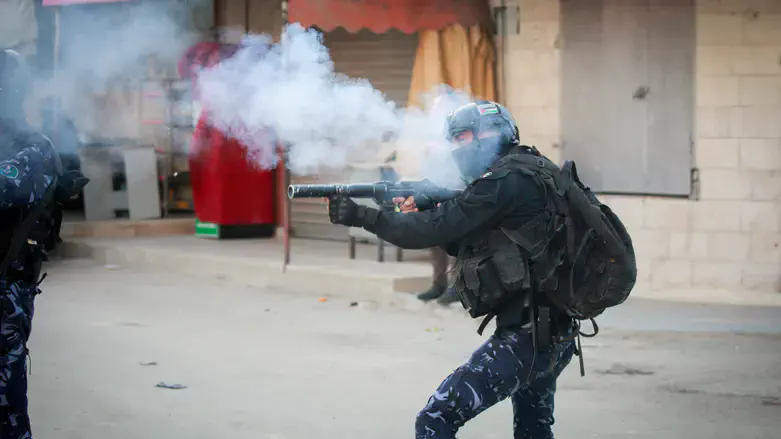
Lt. Col. (res.) Adv. Maurice Hirsch, a researcher at the Jerusalem Center for Security and Foreign Affairs, has published a new study titled "22 Kilometers - The Threat Posed by the Palestinian Authority's Terror Army."
The study warns of the real and growing threat posed by the Palestinian Authority's security forces.
At the outset of the study, Hirsch compares Hamas' October 7 attack with the size of the Palestinian Authority's security apparatus. He notes that approximately 6,000 terrorists infiltrated Israel during the massacre, including around 3,000 trained members of terrorist organizations. By contrast, he estimates that the Palestinian Authority currently maintains some 70,000 armed security personnel in Judea and Samaria, equipped with tens of thousands of firearms. According to Hirsch, these forces train for combat scenarios against Israel and could eventually turn their weapons on the Jewish state.
Hirsch notes that under the Oslo Accords, the Palestinian Authority's police force was limited to 30,000 personnel in total, including 12,000 in Judea and Samaria, equipped with only 4,000 rifles, 4,000 pistols, 120 machine guns, and 15 armored vehicles.
According to the study, that police force has in practice evolved into a large-scale security apparatus comprising approximately 70,000 personnel, extensive military equipment, military training programs, and an organizational structure resembling that of an army.
According to the figures cited, the Palestinian Authority's police already numbered around 18,000 personnel in 1995, despite an authorized limit of only 9,000 at the time. The force subsequently grew to approximately 32,000 in 1997, 40,000 in 2001, 52,000 in 2003, 61,000 in 2006, and around 65,000 in the years that followed.
Hirsch notes that since Hamas seized control of the Gaza Strip in 2007, most of the expansion has taken place within the Palestinian Authority's security forces in Judea and Samaria.
The study adds that members of the Palestinian security forces receive advanced military training through American and European assistance, as well as at Pakistan's military academy. According to the study, this training includes armored warfare, artillery, sniper operations, parachuting, heavy machine gun use, and shoulder-fired missiles. The Palestinian Authority itself presents its personnel in official publications as the "Army of Palestine."
Hirsch also reviews Israeli policy over the years, arguing that successive governments approved the transfer of weapons and armored vehicles to the Palestinian Authority's security forces.
He acknowledges that security coordination between Israel and the Palestinian Authority continues, but argues that in practice the security forces primarily act against Hamas political rivals rather than systematically combating terrorism carried out by Fatah-affiliated groups and other organizations.
A central section of the study examines a scenario known within Israel's defense establishment as the "turning of the guns" - a situation in which members of the Palestinian Authority's security forces turn their weapons against Israel.
Hirsch emphasizes that this is a realistic threat, recalling the participation of Palestinian security personnel in the Second Intifada. He warns that because Judea and Samaria's cities lie within a radius of only about 22 kilometers from Israel's major population centers, such an attack could endanger millions of Israelis, similar to the distance Hamas terrorists penetrated on October 7.
The study concludes by urging the Israeli government to change its policy toward the Palestinian Authority's security forces. Hirsch recommends halting all transfers of weapons to the PA, reducing the size of its security forces to the limits established by the Oslo Accords, creating an independent mechanism to monitor weapons, shutting down military training facilities, preparing operationally for a "turning of the guns" scenario, and working with foreign governments to end military training programs provided to Palestinian security personnel.
"Continuing to ignore the strengthening of the Palestinian Authority's 'terror army' is a dangerous gamble with the lives of millions of Israelis. The writing is on the wall, less than 22 kilometers from the heart of the country. The danger is real and almost certain. To prevent a disaster far greater than the October 7 massacre, we must act proactively before we are left counting the victims."