


The negotiations for a permanent ceasefire between the US and Iran are expected to resume in Pakistan on July 11, Al Arabiya reported.
According to the report, the negotiations will also discuss Iran's nuclear program, economic sanctions placed on Iran, and the IRGC's frozen assets.
Meanwhile, Fox News reported that the Washington-based Institute for Science and International Security (ISIS) has warned that Iran is rebuilding an uninspected underground site in the Zagros Mountains, known as "Pickaxe Mountain."
The report noted that inspectors from the International Atomic Energy Agency (IAEA) have not been allowed to access to the site.
Spencer Faragasso, a senior fellow at the Institute, wrote on X, "The ongoing work at Pickaxe Mountain is deeply concerning. This work has continued steadily since at least 2020. In my view, this is a hedge by Iran in case negotiations fail, they will then have a nuclear facility in a late stage of construction. We assessed that Pickaxe is likely large enough to hold an enrichment plant. If Iran is serious about negotiating, it should halt construction at Pickaxe Mountain as a token of good faith. But what can be expected from a regime as brutal and conniving as Iran's?"
In their original post, the Institute, which posts under the username "TheGoodISIS," wrote, "Recent satellite imagery from late June 2026, of the Natanz Nuclear Complex and the nearby Pickaxe Mountain facility, Fordow, and Esfahan, were provided to the Institute by vantortech."
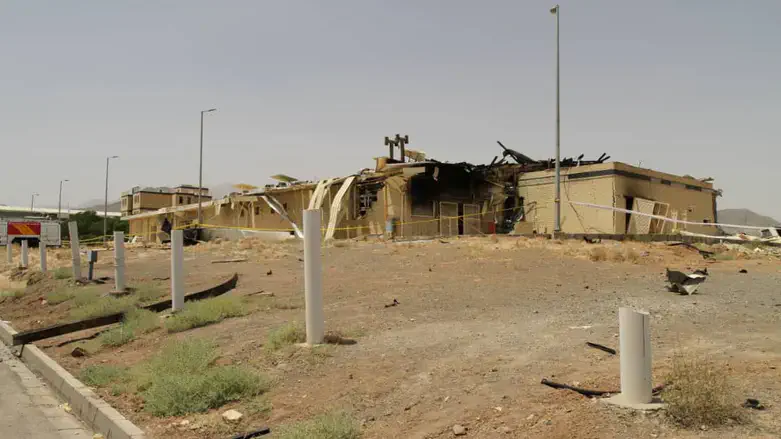
"At Natanz, little activity can be seen. The access points to the below ground enrichment halls have not been repaired. The personnel entrances remain destroyed and vehicle entrances remain severely damaged. A single vehicle can be seen on the road outside of the Pilot Fuel Enrichment Plant (PFEP), which was destroyed in June 2025, but was covered by Iran after. The HVAC chillers remain displaced throughout the complex and the primary and backup power systems remain destroyed.
"At Pickaxe Mountain, vehicle activity can be seen on the roads leading to the open set of Western tunnel portals, indicating that construction inside the tunnel complex, as well hardening of the tunnel entrance, are ongoing. The MOU signed between the United States and Iran requires that Iran maintain the status quo which should prohibit construction at any nuclear related facility, including Pickaxe Mountain. As first reported by the Institute in early May, the Eastern set of tunnel portals remain partially backfilled with dirt, making them inaccessible to ground vehicles. This was likely done to prevent rapid ingress and egress to the tunnel entrances."
The post continued, "At Fordow, as earlier reported by the Institute, between May 10 and May 18th, Iran added passive defensive measures in the form of earthen/rocky mounds and other objects on the roads leading to the tunnel entrances. The alternate placings of the piles/objects are very precise, which creates a series of chicanes, indicating they are not intended as obstructions, but rather to prevent rapid ingress and egress by any vehicle towards the tunnels. The June 21 Vantor image shows that the objects along the road remain there. The tunnel portals also remain backfilled with dirt."
"As of June 29, 2026, there is no observed activity at Esfahan. The tunnel portals remain backfilled with dirt.
"The Institute will continue to monitor these sites for any developments."
In their May post, the Institute wrote, "Based upon newly available satellite imagery of the Pickaxe Mountain underground complex, just south of the Natanz Nuclear Complex, it appears that as early as April 22nd, the two eastern tunnel portals have been partially blocked by grey earthen material used to prevent vehicle access to both portals."
"On April 1, 2026, the portal entrances were clear and unobstructed. Unlike the situation at both the Fordow and Esfahan tunnel entrances, this material does not provide complete tunnel entrance obscuration at either portal. Nonetheless, this material would appear to be sufficient to significantly hinder rapid ingress/egress by vehicles and would require the use of heavy earth moving equipment to gain such access and clear an unobstructed path inside.
"At present, we do not yet see evidence of such a blockage having been undertaken at the two western tunnel portals. This activity raises significant questions as this is a deeply buried tunnel complex that could be used to protect valuable equipment or materials. To note, earlier in the year, we observed how the old tunnel portals to a complex dating back to 2007 at Pickaxe mountain were buried and hardened with concrete, which suggests that something may have been moved into those tunnels."