


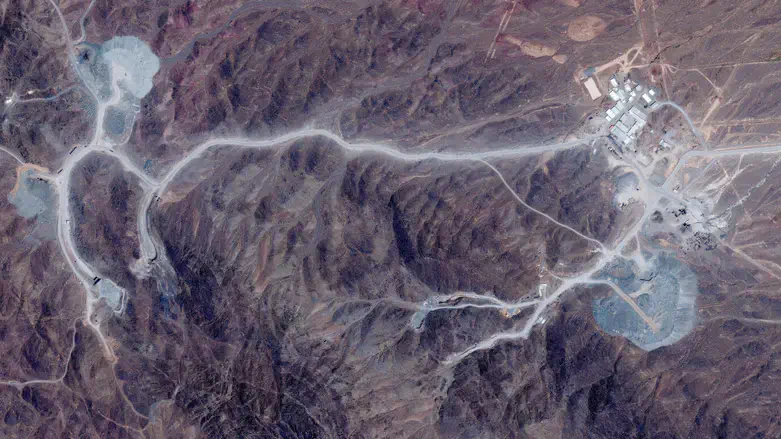
The successful American attack on Fordow in June 2025 does not establish that the United States can do the same thing to Pickaxe Mountain.
Fordow's enrichment halls were reportedly buried approximately 80-90 meters beneath the mountain. Pickaxe Mountain may be deeper.
Based on the elevations of its tunnel entrances and the mountain above them, analysts estimate that parts of the facility could have approximately 80-145 meters of rock overhead.
The precise depth and internal layout are not publicly known. Neither are the GBU-57 Massive Ordnance Penetrator's actual capabilities against different kinds of rock and reinforced underground structures.
But there is another crucial difference.
The GBU-s used against Fordow did not have to penetrate 80-90 meters of solid rock. According to Chairman of the Joint Chiefs of Staff Gen. Dan Caine, the Americans identified two ventilation shafts leading toward Fordow's underground complex.
The Iranians had tried to protect the shafts by covering them with concrete.
The first GBU-57 removed the concrete cap. The bombs that followed then entered the exposed shaft at more than 1,000 feet per second and detonated in what Gen. Caine called the underground "mission space." In other words, the Americans exploited a direct engineered route into Fordow.
There is no reason to assume that Pickaxe Mountain, to which Iran allegedly moved its centriifuges, provides the same opportunity. Straight vertical ventilation shafts may be convenient, but they are not an engineering requirement. Mechanically powered ventilation can be routed through angled, horizontal, dog-legged or baffled passages.
This does not make an underground facility invulnerable.
Tunnel entrances, ventilation systems, electricity, communications, drainage and emergency-access routes can all provide targets. But it may eliminate the exceptionally convenient straight path which the Americans exploited at Fordow.
And the Iranians had every reason to learn this lesson.
Construction of Pickaxe Mountain began following the July 2020 sabotage which severely damaged the advanced-centrifuge assembly facility at Natanz. In September 2020, Iranian nuclear chief Ali Akbar Salehi announced that Iran was building a larger and more modern replacement "in the heart of the mountain."
Iran was not merely replacing a building. It was replacing a vulnerable building with a new facility designed to survive another attack.
We do not know whether Pickaxe Mountain has Fordow-style vertical shafts.
We do not know where its critical chambers are located.
And we do not know whether the United States has identified another way to reach them.
What we do know is that Pickaxe was designed after Iran's vulnerabilities had already been brutally demonstrated.
The Fordow operation was a remarkable technical and operational achievement. But Washington should not assume that Iran left the same door open twice for a conventional solution to the challenge.
Dr. Aaron Lerner is head of IMRA - Independent Media Review and Analysis- since 1992 providing news and analysis on the Middle East with a focus on Arab-Israeli relations.