

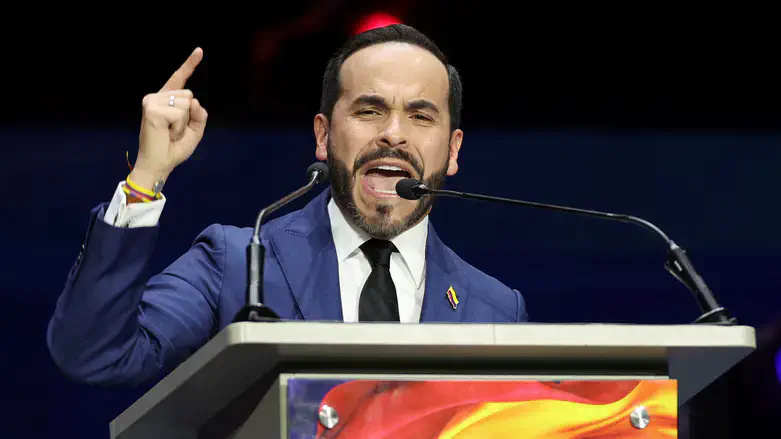
Right-wing political newcomer Abelardo De La Espriella appears on track to secure the Colombian presidency following Sunday's national election.
According to data provided by the country's national registry and reported by Reuters, De La Espriella has captured just under 50% of the vote with nearly 95% of the ballot boxes tallied. His leftist opponent, Ivan Cepeda, currently trails the frontrunner by roughly 368,000 votes, sitting at 48.4%.
Nicknamed “El Tigre," or “The Tiger," the 47-year-old attorney and political outsider built his campaign on a platform of aggressive anti-crime measures, expanding the domestic oil and gas industries, and terminating ongoing state peace negotiations with active armed groups.
A central tenet of De La Espriella’s platform is a pledge to fundamentally shift Colombia's foreign policy by reversing current President Gustavo Petro’s decision from May of 2024 to sever diplomatic relations with Israel over the military conflict in Gaza.
Petro, who has long been critical of Israel, later ordered the opening of an embassy in Ramallah.
In another incident, Petro expressed support for comments made by Brazilian President Luiz Inacio Lula da Silva, who compared Israel’s actions in Gaza to those of Nazi leader Adolf Hitler against Jews during World War II.
Just several weeks ago, the Colombian President posted “Heil Hitler" on X, sparking widespread outrage and controversy. Days later, during a speech at the UN Security Council, Petro compared Israel to the Nazis.
Throughout his campaign, De La Espriella vowed to establish a Colombian embassy in Jerusalem and rebuild a strategic partnership with the country.
Speaking to local media in August 2025 regarding Israel's military actions, De La Espriella defended the operations, stating that Israel was “doing what it must to defend its people - and that is exactly what I will do to defend Colombia. Whatever the cost."
Conversely, the 63-year-old Cepeda had campaigned on a promise to sustain and advance the progressive legislative agenda of the Petro administration.
The highly competitive election also featured a notable protest component, with approximately 400,000 citizens choosing to cast blank ballots instead of supporting either candidate.