

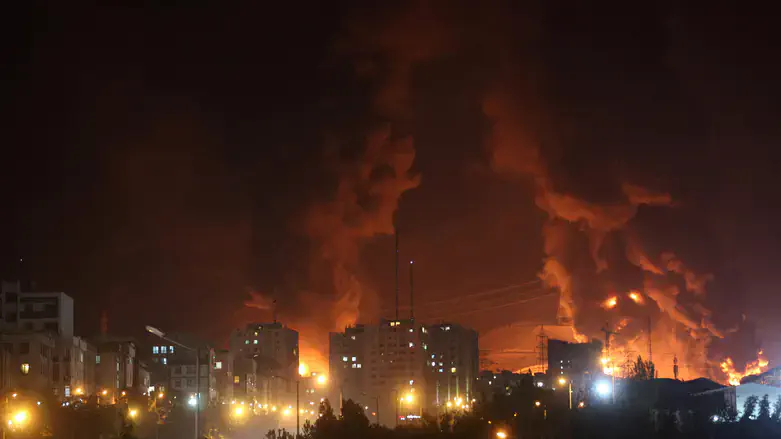
The United States launched strikes in Iran early Thursday morning, a senior US official confirmed, following reports that air defense systems were activated across several regions in the country. This marks the second night in a row that the US has struck targets in Iran.
Among other locations, the systems were activated in Fars Province, on Qeshm Island, and in the capital, Tehran.
Additionally, reports indicate an explosion at the petrochemical plant in Assaluyeh - the largest facility of its kind in the country, responsible for approximately 50% of Iranian petrochemical production. Further explosions were reportedly heard on Kish Island, Qeshm Island, and in Sirik, near the Strait of Hormuz.
US Central Command (CENTCOM) also confirmed that its forces "began launching additional self-defense strikes" against "multiple targets" in Iran.
"The strikes are in response to Iran’s unwarranted and continued aggression," it added.
Several hours later, CENTCOM released another statement summarizing the latest round of strikes.
“US Central Command (CENTCOM) forces completed additional self-defense strikes against multiple targets in Iran, June 10, at the Commander in Chief's direction," it said.
“CENTCOM forces launched strikes on Iranian military surveillance capabilities, communication systems, and air defense sites across Iran. US Marine Corps, Air Force, and Navy assets fired precision munitions on Iranian targets that posed a threat to US forces and international commercial ships transiting regional waters," it added.
“The strikes are in response to Iran's unwarranted and continued aggression. US forces remain vigilant, lethal, and ready," concluded the statement.
A senior US official quoted by Channel 12 News stated that all the targets being struck are located in southern Iran and include air defense systems, radars, and drone command and control units.
Subsequent reports out of Iran indicated an exchange of naval gunfire between Iranian forces and the US military. Concurrently, Iranian state television claimed that United States military vessels operating in the Strait of Hormuz and the Gulf of Oman were targeted in a coordinated attack utilizing Iranian missiles and drones.
The Iranian Revolutionary Guards Corps (IRGC) claimed Iranian air defenses fired a missile at a US Air Force F-16 over the Persian Gulf, forcing the aircraft to take evasive action.
Additionally, the IRGC announced the total closure of the Strait of Hormuz following the US strikes in the region.
In an official statement, the IRGC declared, "As of this moment, due to instability in the region, the Strait of Hormuz is closed to the movement of all types of vessels, including oil tankers and commercial ships. Any vessel attempting to transit will be targeted."
CENTCOM denied Iran’s claims, posting on social media, “CLAIM: Iran's Islamic Revolutionary Guard Corps claims that the Strait of Hormuz is closed."
“TRUTH: Commercial ships are continuing to transit in and out of the Strait of Hormuz tonight."
US President Donald Trump subsequently told Fox News that he had spoken directly to Iranian officials and that those officials had asked him to stop the strikes.
"The attacks will end very soon. We may resume them later," he added, while also stressing that Israel was not involved in this round of strikes.
The Iranian news agency Tasnim, which is closely affiliated with the Islamic Revolutionary Guard Corps (IRGC), denied Trump’s remarks and said: "Trump’s claim that he spoke with Iranian officials who requested a halt to the strikes is an absolute lie. No conversation took place with Trump, and Iran will respond to the aggression against it through military means."
The strikes began just moments after US Secretary of War Pete Hegseth reiterated Trump’s earlier warning of impending military strikes against Iran.
Speaking to reporters at US Central Command (CENTCOM) headquarters in Tampa, Florida, Hegseth said, "CENTCOM will be busy tonight because we are going to hit Iran hard."
He added, “Iran has a chance to make a great deal. They haven't been willing to it...they are going to have tap, tap, tap bombs dropping on key facilities in Iran from the US."
Hegseth stressed that the strikes are “not to restart the war but to set the terms for a deal".
“Those strikes that will happen tonight will be strong and clear and if they have to happen tomorrow night they will be strong and clear. President Trump is prepared to make that deal, Iran would be wise to take it otherwise they will have to deal with the types of plans that I just had a chance to see at CENTCOM," he continued.
Before Hegseth’s comments, Axios reported that Trump convened a high-level Situation Room meeting to deliberate on initiating a fresh round of military operations against Iran.
Insiders revealed to Axios that the Trump administration is weighing an operational framework that would be extensive in magnitude but tightly constrained in its duration. The overarching objective of such a strike would be to apply maximum pressure on Tehran, forcing the regime to shift its current posture within ongoing diplomatic talks.
The individuals familiar with the matter did not provide precise details regarding the exact targets or timeline of the proposed assault.