
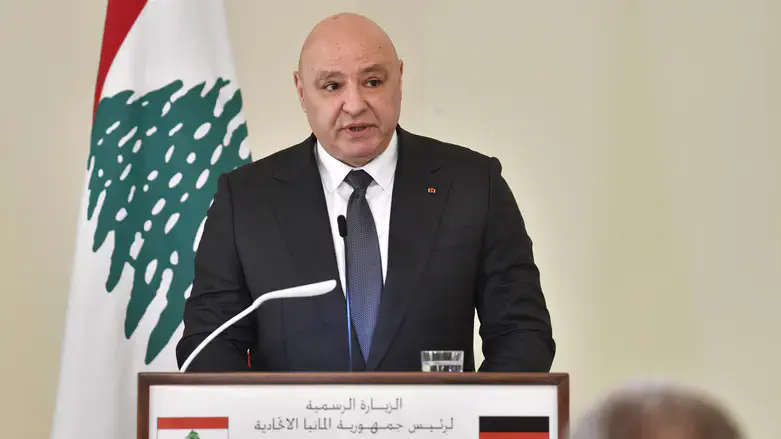
In a forceful condemnation of foreign interference, Lebanese President Joseph Aoun on Friday rebuked Tehran for exploiting his war-torn nation as leverage against the United States and Israel, overriding the desires of the Lebanese public.
In an interview with CNN, Aoun asserted his absolute dedication to rescuing his country from devastation. He emphasized that the domestic population is completely exhausted by the ongoing warfare between Israeli forces and the Iranian-backed Hezbollah terrorist organization.
“We are fed up and we want to live in peace," Aoun said, adding that “(Lebanese people) deserve to live in peace and in dignity, they deserve not seeing their homes being destroyed every five to 10 years."
The Lebanese government had committed to the monumental objective of disarming Hezbollah to diminish its sweeping autonomy and stop the Israeli advance, as part of a US-brokered ceasefire in 2024. Lebanon has remained trapped in the crossfire, however, because Iran has tethered its own peace deal with the US to a demand for an Israeli military withdrawal from Lebanese soil.
Directly challenging the leadership of Iran’s Islamic Revolutionary Guard Corps (IRGC), the primary benefactors of Hezbollah, Aoun delivered a blunt message in the CNN interview.
“It’s not your country, it’s our country," Aoun said. “(Iran is) using Lebanon as a bargaining chip in their negotiation with US."
He added, “You are not trying to help us … the people of Lebanon are paying the price … for the sake of your own interest. Our interests … do not coincide with your interests."
Aoun also commented on his country’s decision to hold direct truce talks with Israel.
“We are ready, we are willing, we are committed (to negotiations to end the war)," he told CNN, adding, “If you are not, you will never live in peace, safety and security," he said addressing the Israeli people and government.
He stated that both nations are facing a pivotal window to dissolve their long-standing enmity so that civilians on both sides of the border can find stability.
“They are both fed up with war since 1948," he added. “This is a huge opportunity. They both have to choose: war or… diplomacy."
Nonetheless, these diplomatic efforts have struggled to take root on the ground, as Hezbollah refuses to lay down its arms while Israeli troops continue to operate against Hezbollah targets in Lebanese territory. Hezbollah chief Naim Qassem has condemned the direct Israel-Lebanon negotiations as an act of submission, asserting the truce framework was roundly dismissed by a vast portion of the Lebanese public.
Aoun countered this narrative, noting that citizens across all religious denominations - including the Shiite community - have personally told him they want an end to Hezbollah's perpetual conflict with Israel.
“They are Lebanese people. They are not Naim Qassem’s people," he said.
Simultaneously, the Lebanese president criticized Israel's strategy for combatting the terrorist organization, arguing that the group can only be resolved by state authorities once the Israeli military pulls back, meaning the crisis must ultimately be settled at the diplomatic table.
“They can invade the whole country, they can flatten the whole country, but they will never be able to achieve their objective," Aoun said on Israel. “Hezbollah is not an objective you can see… it’s an idea."
“I will try… to negotiate and reason with them," Aoun said in reference to Hezbollah and disarmament. “Eventually they will be persuaded, but the cost will be high."
The interview aired two days after a trilateral summit convened by the United States in Washington resulted in a ceasefire agreement between Israel and Lebanon.
A joint statement issued by the three countries on Wednesday stated that the accord dictates that the implementation of the truce is directly "contingent on a complete cessation of Hezbollah fire and the evacuation of all Hezbollah operatives from the South Litani Sector".
The summit marked the fourth round of US-mediated talks between Lebanon and Israel.
After the initial April 23 meeting between the sides, which was attended by the Israeli and Lebanese Ambassadors to the US, Nada Hamadeh Moawad, President Donald Trump expressed hope that peace between Israel and Lebanon would be possible this year.
Trump also said he hopes to host a meeting between Prime Minister Benjamin Netanyahu and Aoun in Washington within a few weeks.
However, Aoun has made clear that a high-level summit with Netanyahu is currently out of the question, stressing that the cessation of hostilities must be the primary focus before any direct political engagement can be considered.
Aoun also recently stressed that Israel’s complete military withdrawal from southern Lebanon is a “non-negotiable" prerequisite for an agreement.
(Israel National News' North American desk is keeping you updated until the start of Shabbat in New York. The time posted automatically on all Israel National News articles, however, is Israeli time.)