

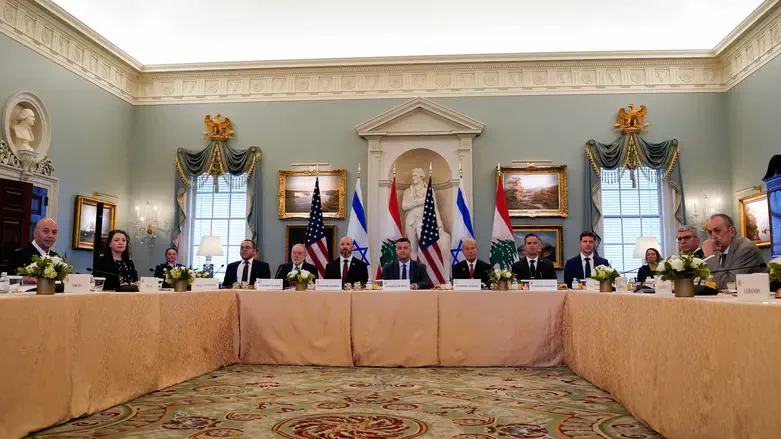
A trilateral summit convened by the United States in Washington has resulted in a ceasefire agreement between Israel and Lebanon, following intensive two-day negotiations on Tuesday and Wednesday.
A joint statement issued following the second day of talks on Wednesday stated that the accord dictates that the implementation of the truce is directly "contingent on a complete cessation of Hezbollah fire and the evacuation of all Hezbollah operatives from the South Litani Sector".
To enforce the peace, Israel and Lebanon agreed to "swiftly advance the creation of pilot zones in which the Lebanese Armed Forces will take exclusive control of the territory to the exclusion of all non-state actors". These stabilization steps are designed to lay the groundwork for "progress towards a comprehensive peace and security agreement".
In a direct rebuke to external interference, the United States, Israel, and Lebanon "rejected any attempt, by any state or non-state actor, to hold Lebanon’s future hostage," while affirming that bilateral relations "must be decided by the two sovereign governments".
Both nations "reaffirmed that they have no hostile intent toward one another and committed to continuing direct negotiations to build confidence".
Building on preceding defense talks held at the Pentagon on May 29, the diplomatic delegations mapped out a strategic security framework. This roadmap is explicitly aimed at "ensuring the sovereignty, security and territorial integrity of Lebanon and Israel," which mandates the "dismantlement of non-state armed groups, and the prevention of their re-emergence". Furthermore, all participating parties "condemned Iran’s attacks on countries in the region, and ongoing activities that undermine stability throughout the Middle East".
Washington emphasized its commitment to bolstering the Lebanese military to enable the "effective exercise of sovereignty throughout Lebanese territory," while referencing a June 2 declaration by US Secretary of State Marco Rubio that "Hezbollah is not just an enemy of Israel and an enemy of America, but that it is an enemy of Lebanon".
For its part, Jerusalem maintained that its national safety can "only be achieved through the disarmament of Hezbollah and the dismantlement of its infrastructure throughout Lebanon". Conversely, Beirut stressed "the necessity for mutual respect of internationally recognized borders" and "the urgent need for full implementation of the cessation of hostilities".
The two sides are scheduled to officially "reconvene the political and security tracks the week of June 22, with a view toward reaching a comprehensive agreement," with the United States maintaining its role as the central mediator.
Commenting on the agreement, Israel’s Ambassador to the US, Yechiel Leiter, said, “What today’s outcome reiterates: Israel and Lebanon want Iran out of our region."
He added, “Together, we will work to make sure that Iran and its terror proxies won’t continue to wreak havoc on our lives in the name of terror and destruction."
Tuesday and Wednesday’s meeting marked the fourth round of US-mediated talks between Lebanon and Israel.
After the initial April 23 meeting between the sides, which was attended by Ambassador Leiter and Lebanon’s Ambassador to the US, Nada Hamadeh Moawad, President Donald Trump expressed hope that peace between Israel and Lebanon would be possible this year.
Trump also said he hopes to host a meeting between Prime Minister Benjamin Netanyahu and Lebanese President Joseph Aoun in Washington within a few weeks.
However, Aoun has made clear that a high-level summit with Netanyahu is currently out of the question, stressing that the cessation of hostilities must be the primary focus before any direct political engagement can be considered.
Aoun also recently stressed that Israel’s complete military withdrawal from southern Lebanon is a “non-negotiable" prerequisite for an agreement.