

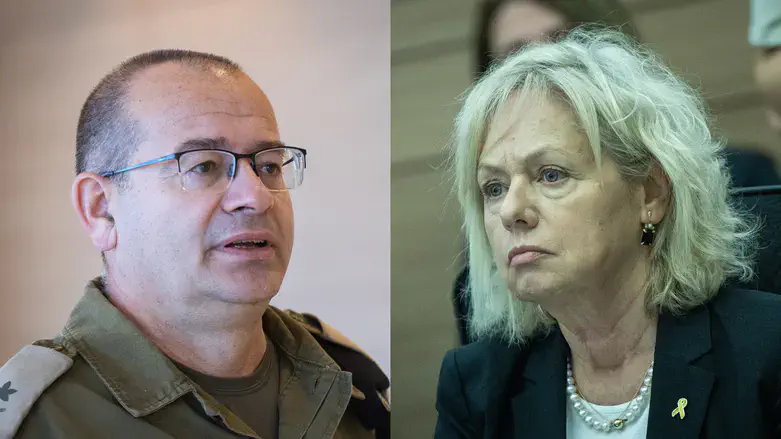
Attorney General Gali Baharav-Miara submitted her official position to the Supreme Court early Thursday morning regarding the petition against the appointment of Roman Gofman as Mossad chief, arguing that the appointment should be disqualified.
The position was submitted late, despite a series of extensions granted by the Supreme Court justices, who had required that the document be submitted no later than midnight.
In her response, the Baharav-Miara sharply criticized the decision of the majority of the Advisory Committee for Senior Appointments, which approved the appointment.
According to her, the majority opinion is characterized by a clear bias aimed at minimizing Gofman’s role and clearing him of responsibility, and she therefore determined that the decision does not meet the legal requirements.
Baharav-Miara is asking the court to disqualify the majority’s conclusions and instead rely on the minority position of the committee’s chairman, retired Justice Asher Grunis.
However, her position does not include any reference to Grunis’ updated position, according to which the matter should be examined more deeply - an omission that is especially notable in the submitted document.
The Attorney General pointed an accusing finger at the conduct of the committee members, writing that from reading the protocols, it is difficult to avoid the impression that some members of the majority had made up their minds to approve the appointment no matter what, and as a result ignored data and information that did not support their thesis.
At the center of the disqualification is what the Attorney General alleges is a severe ethical failure, which she said harms the integrity required of the head of an intelligence organization. The document states that Gofman’s failure to disclose what he knew, in the highly sensitive context of a security-related criminal investigation, harmed the search for truth and severely harmed suspect Uri Elmakayes’ rights.
Baharav-Miara rejected Gofman’s line of defense, alleging that the claim that the inquiry conducted by the head of the Operations Division focused only on the question of the leak of classified material does not cleanse the serious ethical flaw. The fact is, the response claimed, that Gofman was asked directly about contact, directly or indirectly, with a Telegram channel, and refrained from telling the truth, even after the channel operator was arrested.