

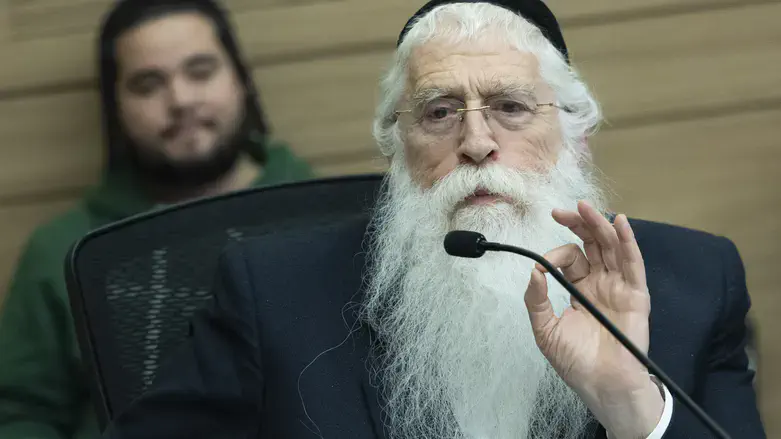
Shlomei Emunim chairman MK Meir Porush spoke Tuesday night at a conference of hundreds of community leaders in Beit Shemesh, addressing at length the political crisis surrounding the failure to regulate the status of yeshiva students.
Porush pointed an accusing finger at the judicial system, while also not sparing Prime Minister Benjamin Netanyahu from criticism.
"Already a year ago and more, I said that haredi Judaism has not had such a difficult period as this since the establishment of the State," he began. "Everything that was built with great effort over decades, based on the understandings reached at the time of the establishment of the State, and central to this, the regulation of yeshiva students' status, is being trampled crudely by jurists who are disconnected from any spark of Judaism."
"I do not want to dwell too much on the past, since it is no longer so relevant - although lessons must be learned from the mistakes made then. It is no secret, and I cried this out from the first moment, that the status of yeshiva students should have been regulated even before the formation of the government."
Porush noted, "There were several laws that were advanced then before the government was formed, but the regulation of the status of yeshiva students was postponed until the budget."
"I believe there is no one in haredi Judaism who disagrees with that today, and certainly everyone will agree that in any situation in the next term, if it depends on us, we will have to demand this and insist on it: We do not enter a coalition and do not take positions until this matter is settled. Otherwise, what? Will we wait another three or four years?"
Later in the speech, he addressed at length the conduct throughout the term: "When we come to speak about this term, it must mainly be divided into two periods: Until that bitter and terrible day, Simchat Torah 5784, October 7[, 2023] in the secular calendar, and from that day onward."
"The reality is that there is hardly anyone in Likud whose children study [Torah] day and night; they do not live with our concepts."
He recalled, "Until that day, we had the political ability to advance our policy, and I referred to that as stated. But from that day, everything changed and nothing changed. Everything changed in terms of Israeli society, nothing changed in terms of the judicial system. On the contrary, it became worse. There is no day when its curse is not greater than the previous one."
"The war created a real challenge for the issue of regulating the status of yeshiva students. Until then, the issue was mainly political; whoever wanted to gain mandates on the left would incite his voters against us, and whoever had voters with a greater affinity for tradition agreed to an arrangement we could live with.
"After the war broke out, even those who until that day had agreed to an arrangement no longer really agreed. Perhaps they agreed to promise, but not to regulate."
Porush also revealed a conversation he had at the time with Netanyahu: "When I demanded that the law be passed before the government was formed, Netanyahu told me that he had four problematic MKs in Likud whom he needed to straighten out, and according to him, closer to the budget it would be easier for him to do so. Of course, I did not accept this delay, but that is what he said."
"About a year after his government was formed and things still had not moved with Netanyahu, I said in an interview, ‘If Netanyahu cannot? Let him go home!’ People were angry at me and said this was an attack on the Prime Minister. True, but it turned out that the excuse remained the same excuse, and he has no ability to pass the law regulating the status of yeshiva students."
Porush also noted that this is unprecedented conduct on the part of the judicial system: "The issue of regulating the status of yeshiva students is one that I am familiar with, in depth, for quite a few years. But the rituals we are seeing today in the directives of the legal counsel and in the rulings of the Supreme Court - we have never seen. The burning hatred of ignoramuses toward Torah scholars drips between the lines, to the extent that by law it would be fitting to tear one’s garment [in mourning] over every such document."
"It is no coincidence that the entire United Torah Judaism faction recently decided to support any move that will diminish the insane power of the judicial system. We need to be there, and to ensure that these decisions express the possibility of putting an end to the despotism of the judicial system.
"I tell you here unequivocally: Do not deceive yourselves - only if we put an end to the judicial dictatorship will we be able to stop this campaign of persecution. Without that, any law we legislate will not hold water."
At the end of his remarks, Porush sent a sharp message to Deputy President of the Supreme Court Noam Sohlberg, who signed rulings against yeshiva students: "The Gerrer Rebbe, of blessed and holy memory, came here to the Land after 100 members of his family were killed in the Holocaust. The Belzer Rebbe, of blessed and holy memory, came after his family perished in the Holocaust. The Brisker Rav, of blessed and holy memory, came here after losing his wife and three of his children. The Ponevezher Rav, of blessed and holy memory, also came to the Land after losing his wife and children."
"They rose from the ashes, came here, to the Land of Israel - not to the State of Israel, they came to the Land of Israel. Why did they come here? They came here in order to establish yeshivas, to rebuild the Torah world.
"Who are you, Sohlberg, to come and tell these yeshiva students to close the Gemara? Who are you to say that the yeshivas of Gur, Belz, Brisk, and Ponevezh should be closed? Who appointed you? Who are you, anyway?"