

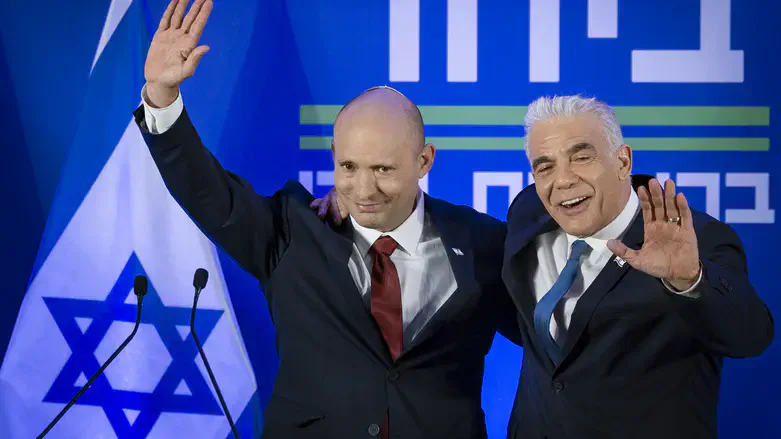
If elections were held today, the center-left bloc would be able to form a coalition without the Arab parties, a new Maariv poll showed.
The "Together" party led by former prime ministers Naftali Bennett and Yair Lapid would be largest in the Knesset, with 26 seats, with the Likud party following close behind at 25 seats.
"Yashar!" led by Gadi Eisenkot would be third-largest in the Knesset, with 16 seats, while the Democrats party would win 10 seats.
Among the smaller parties, Shas and Yisrael Beytenu would win nine seats each, Otzma Yehudit would win eight seats, and United Torah Judaism (UTJ) would win seven seats.
The Arab parties, Hadash-Ta'al and Ra'am (United Arab List) would win five seats each.
The Reservists, Blue and White, Religious Zionism, and the Arab "Balad" would all fail to pass the electoral threshold.
Divided into blocs, the center-left would win 61 Knesset seats, enough to form a narrow coalition, while the current coalition parties would win 49 seats. The remaining 10 seats would be held by the Arab parties, which traditionally join neither coalition.
If the Reservists party merged with MK Chili Tropper, who announced earlier this month that he would leave Blue and White, the Reservists would pass the threshold, pulling one seat each from Likud, Yashar!, Together, and Yisrael Beytenu. In such a scenario, the coalition bloc would win 48, while the center-left bloc would win 62 seats; the remaining 10 would remain in the hands of the Arab parties.
If Together, Yashar!, and Yisrael Beytenu ran as a joint list, the resulting party would win 49 seats, while Likud would win 26. The Democrats would be third-largest in the Knesset with 11 seats, while Shas would win nine, Otzma Yehudit eight, and UTJ seven. The Arab parties would maintain their 10 seats, with five each for Ra'am and Hadash-Ta'al. In such a case, the center-left would win 60 Knesset seats, and the current coalition 50.