

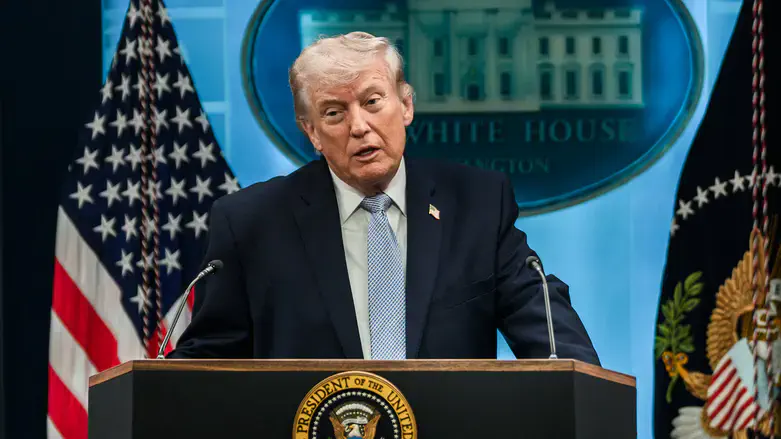
US President Donald Trump announced on Sunday that the United States will lead a humanitarian operation, starting on Monday morning, to free dozens of neutral foreign vessels trapped in the Strait of Hormuz, an area engulfed in regional tensions primarily involving Iran.
In a detailed Truth Social post, the President emphasized that the ships belong to countries uninvolved in the Middle East conflict and described the effort as a goodwill measure benefiting global commerce, the region, and even Iran itself.
"Countries from all over the World, almost all of which are not involved in the Middle Eastern dispute going on so visibly, and violently, for all to see, have asked the United States if we could help free up their Ships, which are locked up in the Strait of Hormuz, on something which they have absolutely nothing to do with - They are merely neutral and innocent bystanders!" Trump wrote.
“For the good of Iran, the Middle East, and the United States, we have told these Countries that we will guide their Ships safely out of these restricted Waterways, so that they can freely and ably get on with their business. Again, these are Ships from areas of the World that are not in any way involved with that which is currently taking place in the Middle East," he added.
“I have told my Representatives to inform them that we will use best efforts to get their Ships and Crews safely out of the Strait. In all cases, they said they will not be returning until the area becomes safe for navigation, and everything else. This process, Project Freedom, will begin Monday morning, Middle East time," continued Trump’s post.
Commenting on the ongoing negotiations with Iran, Trump wrote, “I am fully aware that my Representatives are having very positive discussions with the Country of Iran, and that these discussions could lead to something very positive for all. The Ship movement is merely meant to free up people, companies, and Countries that have done absolutely nothing wrong - They are victims of circumstance. This is a Humanitarian gesture on behalf of the United States, Middle Eastern Countries but, in particular, the Country of Iran."
“Many of these Ships are running low on food, and everything else necessary for largescale crews to stay on board in a healthy and sanitary manner. I think it would go a long way in showing Goodwill on behalf of all of those who have been fighting so strenuously over the last number of months. If, in any way, this Humanitarian process is interfered with, that interference will, unfortunately, have to be dealt with forcefully," concluded Trump.
On Saturday, Trump said that he would be reviewing the latest proposal sent by Iran to end the war, while expressing doubt that the proposal would be satisfactory.
“I will soon be reviewing the plan that Iran has just sent to us, but can’t imagine that it would be acceptable in that they have not yet paid a big enough price for what they have done to Humanity, and the World, over the last 47 years. Thank you for your attention to this matter!" Trump wrote in a post on Truth Social.
The post came shortly after Trump was asked by reporters whether restarting military strikes against Iran is a possibility.
The President replied, "I can't tell that to a reporter. If they misbehave, if they do something bad - but right now, we'll see. It's a possibility that could happen, certainly."
On Sunday, Trump told Kan 11 News that the new Iranian proposal is "not acceptable."
Trump stated that he had reviewed the proposal and rejected it. "I studied the new Iranian proposal, and it is not acceptable to me," he said in the interview.
He added that "the campaign is progressing very well."
Earlier on Sunday, a report by Al Jazeera detailed the 14-point proposal, outlining terms for a permanent end to the ongoing conflict, including a timeline to resolve all issues within 30 days.
According to the report, the proposal, delivered via Pakistan in response to a US-backed nine-point plan, prioritizes a comprehensive resolution rather than an extension of the current ceasefire. The plan calls for guarantees against future military attacks, the withdrawal of US forces from areas surrounding Iran, and the lifting of sanctions imposed over decades.
The proposal also includes demands for the release of frozen Iranian assets worth billions of dollars and the payment of war reparations. Tehran is further seeking an end to all hostilities, including fighting in Lebanon, as part of a broader regional de-escalation.
A central component of the proposal is the establishment of what was described as a new mechanism governing the Strait of Hormuz, through which a significant portion of global energy supplies pass. The issue of navigation in the strait remains a key point of contention between the sides.
In addition, Iran is demanding guarantees for its right to uranium enrichment as a signatory to the Nuclear Non-Proliferation Treaty, making the issue part of the broader framework for a final agreement.