


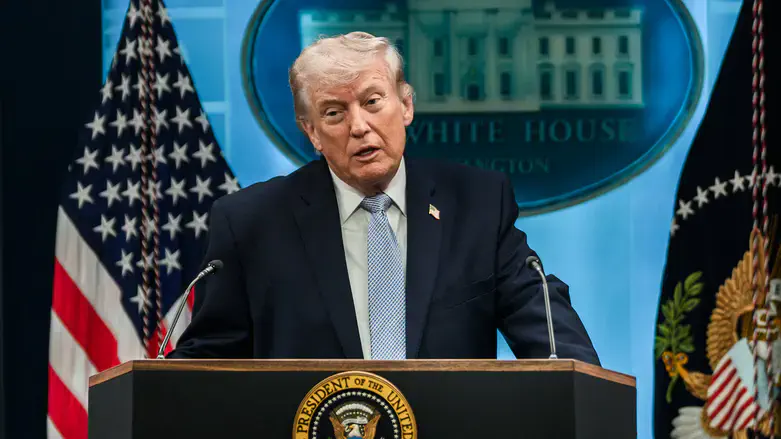
US President Donald Trump told Kan News on Sunday that the new Iranian proposal is "not acceptable."
Trump stated that he had reviewed the proposal and rejected it. "I studied the new Iranian proposal, and it is not acceptable to me," he said in the interview.
He added that "the campaign is progressing very well.
The US President also reiterated his call for President Isaac Herzog to grant a pardon to Prime Minister Benjamin Netanyahu. "He is a prime minister during wartime. Israel would not have existed without me and Bibi, in that order. You need a prime minister who can focus on the war and not on nonsense," Trump stated.
A short time earlier, Iran announced that it had received the US administration’s response to its proposal and was "reviewing it."
Earlier on Sunday, a report by Al Jazeera detailed the 14-point proposal, outlining terms for a permanent end to the ongoing conflict, including a timeline to resolve all issues within 30 days.
According to the report, the proposal, delivered via Pakistan in response to a US-backed nine-point plan, prioritizes a comprehensive resolution rather than an extension of the current ceasefire. The plan calls for guarantees against future military attacks, the withdrawal of US forces from areas surrounding Iran, and the lifting of sanctions imposed over decades.
The proposal also includes demands for the release of frozen Iranian assets worth billions of dollars and the payment of war reparations. Tehran is further seeking an end to all hostilities, including fighting in Lebanon, as part of a broader regional de-escalation.
A central component of the proposal is the establishment of what was described as a new mechanism governing the Strait of Hormuz, through which a significant portion of global energy supplies pass. The issue of navigation in the strait remains a key point of contention between the sides.
In addition, Iran is demanding guarantees for its right to uranium enrichment as a signatory to the Nuclear Non-Proliferation Treaty, making the issue part of the broader framework for a final agreement.
The proposal follows weeks of stalled negotiations despite a ceasefire that took effect on April 8. While Iran has pushed for a permanent resolution to the war, the United States has maintained conditions related to reopening the Strait of Hormuz and limiting Iran’s nuclear capabilities.
Trump said on Saturday that he was reviewing the proposal but expressed doubt that it would be acceptable, and warned that military action could resume if Iran engages in further hostile activity.
Previous diplomatic efforts have included multiple proposals from both sides, including earlier Iranian plans and a US draft that called for a temporary ceasefire during negotiations. Despite reports of some flexibility in recent discussions, gaps remain on core issues, particularly regarding Iran’s nuclear program and control of the Strait of Hormuz.
The Al Jazeera report noted that the proposal reflects ongoing efforts to transition from a temporary truce to a permanent agreement, even as tensions persist between the sides.