
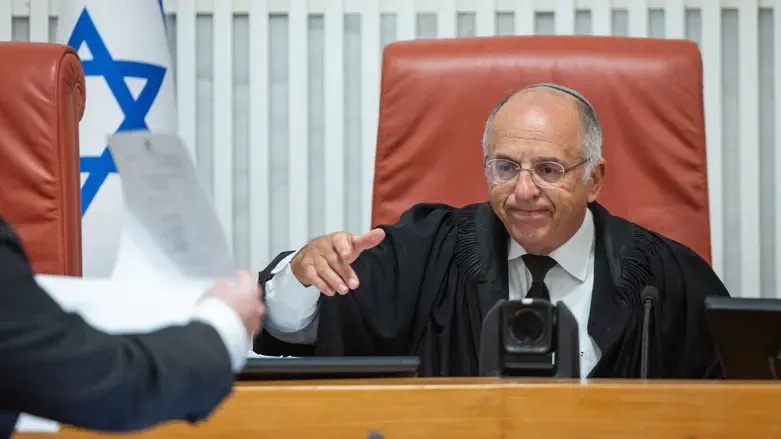
Israel’s Supreme Court held a hearing Thursday before an expanded panel of seven justices on petitions calling for the creation of a state commission of inquiry into the failures surrounding the October 7th massacre and the ensuing years of war.
The panel heard arguments from government representatives, legal officials, bereaved families, and members of Knesset. Only a small number of grieving relatives were permitted into the courtroom.
At issue is whether the court should turn its earlier temporary order, directing the government to consider establishing a commission, into a binding decision.
The proceedings were briefly disrupted when protesters attempted to force their way into the courtroom, prompting security to evacuate the judges. The hearing resumed after order was restored.
Early in the session, Justice Sohlberg challenged the government’s position against forming a commission, asking what alternative mechanism it proposed. Government representative Adv. Michael Ravilo argued that the court lacks authority to compel the executive branch to establish such a body, calling the petitioners’ request unprecedented both in Israel and internationally. He emphasized that the government had already debated the issue and decided against creating a commission.
A further challenge from the bench questioned whether the court truly has no authority even if the government reverses a prior position supporting an inquiry. Ravilo maintained that the decision ultimately rests with elected officials, even in the case of clear conflicts of interest.
During the hearing, bereaved families voiced anguish and frustration, with some calling for scrutiny of the judiciary itself. One father told the court that acknowledging their pain was not enough and urged judges to allow families to fully express their grievances.
Ravilo later added that, in the government’s view, any commission should only be established after "victory on all fronts." The statement drew shock and criticism from the judges.
Representing the Attorney General, Adv. Yonatan Berman stressed the urgent need for an investigation, warning that delays could undermine its effectiveness. He rejected alternative frameworks, insisting that only a formal state commission of inquiry would be appropriate.
Justice Sohlberg cautioned against the potential consequences of a court-imposed order at this stage, particularly given the proximity of elections and concerns about public trust. The judges suggested it might be preferable to leave the decision to a future government, asking whether the issue should ultimately be decided by the public at the ballot box.