
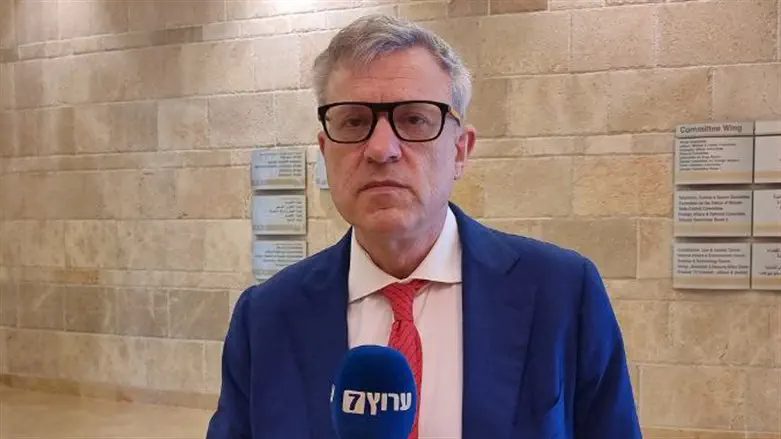
In an interview with Arutz Sheva-Israel National News, Dr. Dan Diker, President of the Jerusalem Center for Security and Foreign Affairs, addressed the initial contacts in negotiations with Lebanon, raising doubts about the significance of talks with a government that lacks full control over armed factions within its borders.
According to Diker, elements within Lebanon’s leadership support Hezbollah, while many soldiers and commanders in the Lebanese army are Shiites who sympathize with and cooperate with the organization.
“There is significant value in the very existence of meetings around a table in Washington under US auspices, with the dialogue led by Marco Rubio, together with our ambassador Dr. Yechiel Leiter," Diker said. He emphasized that the primary importance is symbolic, carrying considerable psychological weight in the Middle East.
Diker pointed to the negotiations nearing completion in 1983, which ultimately failed after Syrian intervention prevented parliamentary approval and led to the assassination of Lebanon’s president. At the time, Syria operated under Iranian patronage. Today, he noted, the threat to Lebanon comes from Hezbollah, which is likewise backed by Iran, limiting the effectiveness of current talks and reducing the chances of a successful agreement.
Nevertheless, Diker stressed that the very holding of such meetings sends a clear message to Tehran that Lebanon, once under Iranian influence, is no longer fully aligned and is capable of independent political considerations.
He also highlighted similarities between the current negotiations and those of 1983, noting that both took place alongside an Israeli military presence in southern Lebanon up to the Litani River. From this, Diker concluded that Israel, under Prime Minister Benjamin Netanyahu, is not pursuing a framework involving ceasefires, concessions, or withdrawals, and will insist on maintaining defensible borders as part of any potential agreement.
“We will need to safeguard Israel’s borders for a long time beyond our own borders; in Lebanon, Syria, and Gaza," he said.
Diker further stated that Israel is effectively applying the same strategy in Lebanon as that pursued by US President Donald Trump toward Iran - maximum pressure combining diplomacy with continued military action. He cited Trump’s approach in the Strait of Hormuz and suggested that Israel is similarly continuing strikes against Hezbollah while engaging in talks with Lebanon. In his assessment, Israel is already assisting Lebanon in military, intelligence, and strategic aspects.
Diker emphasized that the Lebanese arena is not isolated but part of a broader regional campaign against Iran and its proxies. Israel seeks to isolate this front while gaining legitimacy from Lebanon itself, despite recognizing that the country is unlikely, and possibly unwilling, to disarm Hezbollah, given deep familial and sectarian ties between senior Lebanese military figures and the Shiite community.
Disarming the Shiite militia under such conditions is not feasible, he said, but the current situation presents an important opportunity within a much wider struggle against the Iranian regime.
“This is the severing of one of the arms of the Iranian octopus," Diker concluded, also noting the importance of the economic pressure imposed by President Trump on Iran as another key component of the broader campaign.