

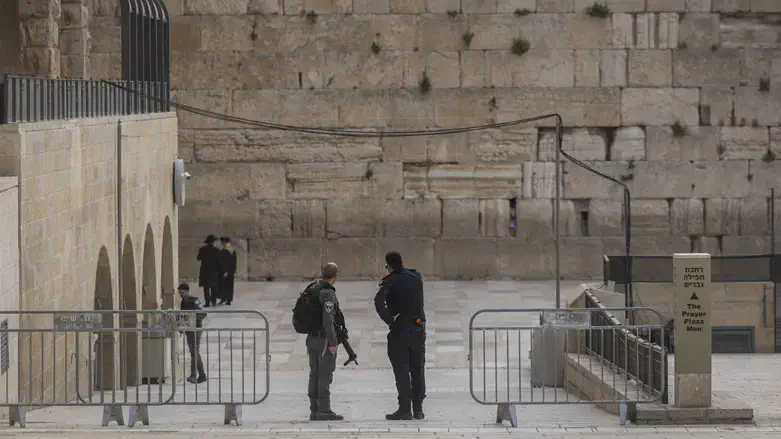
The Supreme Court held a hearing on Sunday on a petition requesting permission to open the Western Wall and the Temple Mount to hundreds of worshippers.
The petition followed a ruling a day earlier allowing large-scale demonstrations in Habima Square, a decision that drew criticism from religious and traditional communities, who argued it reflected unequal enforcement of freedom of assembly.
During the hearing, Court President Yitzhak Amit emphasized the need to balance competing considerations. He noted that seeing the Western Wall largely empty during the Priestly Blessing broadcast was “embarrassing," describing the site as the spiritual center of the Jewish people. However, he also cautioned that differences between secured areas like Habima’s parking facilities and the more exposed Western Wall plaza must be taken into account.
Police presented a proposal to allow groups of up to 150 worshippers to enter at a time, alongside a plan for rapid evacuation in the event of an alarm. The outline has the backing of National Security Minister Itamar Ben-Gvir, despite his broader opposition to large gatherings under current conditions.
The court later issued an interim ruling allowing groups of up to 100 worshipers into the Western Wall plaza.
Ben-Gvir reiterated his criticism of the earlier court decision permitting demonstrations, calling it “problematic and incorrect." He warned against mass gatherings at demonstrations or holy sites, urging the public to act responsibly. At the same time, he argued that once protests were approved, authorities could not impose stricter limitations on access to the Western Wall and Temple Mount, saying such a distinction would unfairly discriminate against worshippers.
In contrast, representatives of the Home Front Command presented a more restrictive position. They said the limited number of protected spaces near the Western Wall, capable of holding only a few dozen people each, means that no more than around 100 worshippers can safely be present at one time, in order to ensure rapid access to shelter during alerts.