

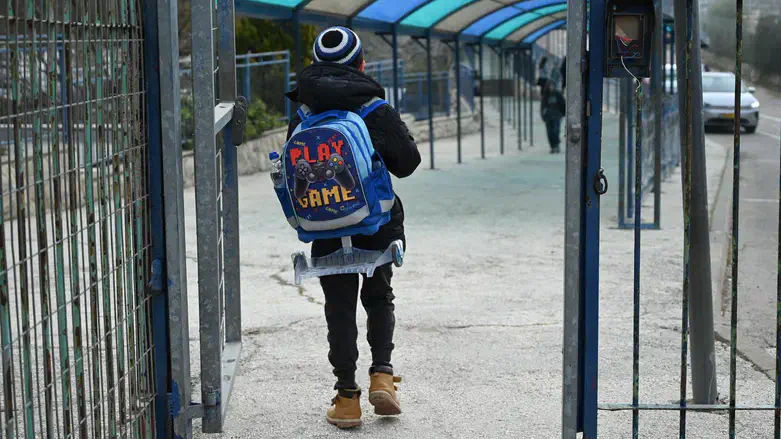
The education system partially reopened Monday in several areas in accordance with Home Front Command guidelines.
However, most Israeli students will continue studying through remote learning.
The easing of restrictions applies to the Beit She’an Valley, western Lachish, the Gaza border communities, the western and southern Negev, Samaria, Judea, the Jordan Valley, the Dead Sea area, and the Arava.
Schools will operate fully in Arad, Netivot, Yeruham, Ma'aleh Adumim, and in the Gush Etzion, Efrat, and Eshkol regional councils.
In Sderot, special education frameworks will open, along with daycare centers only for children whose parents are part of the city’s education staff and must report to work, or children whose parents both work in the security system, as well as preschools and grades 1-2.
In Netivot, daycare centers and special education institutions will open only on Tuesday. In the Sha’ar Hanegev Regional Council, daycare centers, preschools, and special education in schools will operate. In the Mount Hebron Regional Council, preschools and daycare centers with proper shelter will open, along with grades 1-2. In the Hof Ashkelon Regional Council, daycare centers, preschools, grades 1-3, and grades 11-12 will operate.
However, several mayors decided not to open schools at all despite the change in guidelines, among them Ashkelon, Dimona, Ariel, and Ofakim. Ashkelon Mayor Tomer Glam explained his decision: “We will not take risks with our children. The threat still exists and the launches are continuing."
Studies will take place only in institutions with bomb shelters which meet the standards. In addition, organized transportation will not operate, and parents will be required to bring their children independently in order to avoid prolonged and dangerous travel on unprotected routes.
Education Minister Yoav Kisch addressed the continued uncertainty in the Tel Aviv metropolitan area and other major population centers, where stricter policies remain in place.
“Because the Iranians are targeting the large population centers, as long as there is no decrease in the number of launches - we will remain with remote learning there," Kisch clarified.
According to him, this assessment is expected to remain in effect at least until the Passover break, unless there is a dramatic change in the security situation.