

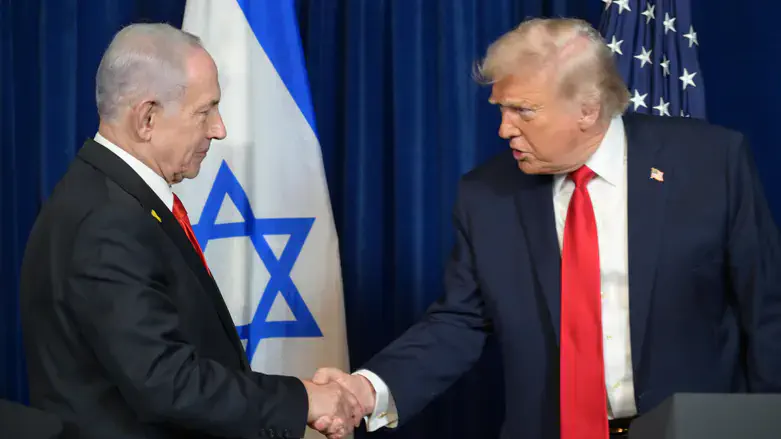
A phone call between Prime Minister Benjamin Netanyahu and US President Donald Trump last month played a key role in the decision to strike Iran, according to a report published Tuesday by Axios.
According to the report, Netanyahu called Trump on February 23 to relay intelligence indicating that Iran’s Supreme Leader, Ayatollah Ali Khamenei, and his top advisers were expected to meet at a single location in Tehran on the morning of Saturday, February. 28.
Three sources briefed on the discussion told Axios that Netanyahu informed Trump that the group could potentially be killed in a single airstrike.
The call, which was conducted from the White House Situation Room, had not previously been reported. According to the report, the conversation proved to be a pivotal moment in the events that ultimately led to the outbreak of the latest war with Iran.
The report states that the opportunity to target Khamenei and his inner circle was seen as a rare intelligence opportunity that neither Trump nor Netanyahu wanted to miss.
Trump had already been considering a strike on Iran before receiving the intelligence, but had not yet decided on the timing. The information provided during the call helped shape that decision.
According to US and Israeli officials cited in the report, the February 23 call was part of months of coordination between the two leaders. Trump and Netanyahu met twice and spoke by phone 15 times during the two months leading up to the strike.
The two countries had considered carrying out the attack a week earlier, but the operation was delayed due to intelligence and operational factors, including weather conditions.
At Trump’s direction, the CIA conducted an initial review that confirmed the intelligence collected by Israeli military intelligence regarding Khamenei’s planned meeting.
Preparations then accelerated. Trump told Netanyahu he would consider moving forward, but first delivered his State of the Union address the following evening.
According to US officials, Trump made a “deliberate decision" not to place heavy emphasis on Iran in the speech in order to avoid alerting Khamenei and prompting him to change his movements before the strike could take place.
By Thursday, the CIA had fully confirmed that the Iranian leadership would be gathered together.
“Confirmed that these people were all going to be together, and we needed to take advantage of it," a source told Axios.
The same day, Trump’s envoys Jared Kushner and Steve Witkoff called from Geneva following hours of talks with Iranian officials and delivered a bleak assessment of the negotiations.
Following those developments, Trump concluded that the intelligence was reliable and that diplomatic efforts had reached a dead end. On Friday at 3:38 p.m. EST, he gave the final order for the strike.
Eleven hours later, bombs fell on Tehran, Khamenei was killed, and the conflict began.
One Israeli official told Axios that Trump had initially wanted to strike earlier in early January, but that Netanyahu asked for the operation to be delayed.
The official emphasized that the timing was “fully coordinated" with the understanding that the operation would be conducted jointly.
According to the report, the original plan called for a strike in late March or early April in order to allow the administration time to build public support.
However, Netanyahu urged a faster timetable, a US official told Axios, warning that Iranian opposition leaders hiding in safe houses could be at risk from the regime. The accelerated timeline left the administration with little time to build a public case for military action.
Israeli Ambassador to Washington Yechiel Leiter declined to comment on details of the February 23 call but rejected claims that Netanyahu had pushed aggressively to accelerate the strike.
“Over the past year, we have worked more closely than ever with our partners in the United States regarding Iran, and we see eye to eye on the danger Iran poses to Israel, to the United States, and to the free world," Leiter told Axios.
“Anyone who knows President Trump understands that he is a strong leader who cannot be steered," the ambassador added.