

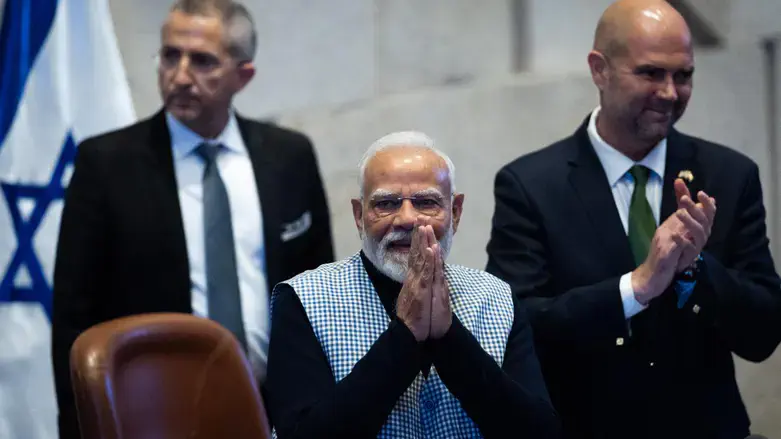
A survey conducted by the "Lazar Research Institute" for the Maariv newspaper shows that most Israelis (53%) believe it was wrong for the opposition to boycott the ceremonial session in the Knesset with Indian Prime Minister Narendra Modi. 24% think it was the right move, while 23% have no opinion on the matter.
59% of the public believes that avoiding a US strike on Iran would be a very bad outcome for Israel.
In the political arena, in most of the scenarios tested - including a joint run by Naftali Bennett and Gadi Eizenkot - the opposition bloc remains at 60 seats, the coalition has 50, and the Arab parties have 10 seats, meaning Netanyahu's opponents cannot form a government without relying on the Arab parties.
For example, with the current parties and without mergers, the Likud party receives 26 seats, Bennett 19, Yesh Atid with Eizenkot 14, the Democrats 11, Otzma Yehudit 9, Yisrael Beytenu 8, Shas 8, Yesh Atid 8, United Torah Judaism 7, Hadash-Ta'al 5, and Ra'am 5.
The Blue and White, Religious Zionism, the Reservists, and Balad parties do not cross the electoral threshold.
A joint list run would weaken the anti-government bloc to 57 seats, the right-wing bloc would reach 49, and the Arab parties would strengthen to 14 seats combined.