

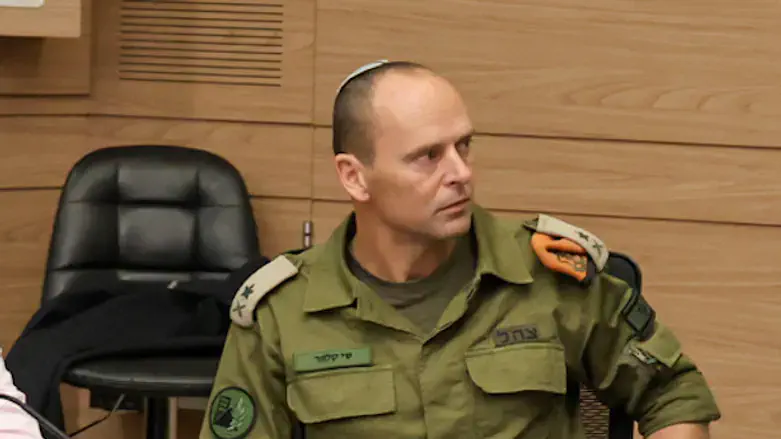
The Knesset's Foreign Affairs and Defense Committee on Wednesday heard a confidential briefing from Home Front Command Chief Major General Shai Klapper.
During the session, Klapper responded in detail to questions from the Knesset members.
The discussion focused on the Home Front’s preparedness for multi-theater operational scenarios in light of the tensions with Iran, while presenting lessons from the "Iron Swords" war and "Operation Rising Lion."
During the briefing, General Klapper emphasized that the Home Front Command is a critical component of Israel's national resilience and operational capability to save lives. He detailed the synchronization with the National Emergency Authority (NEA) and local authorities and clarified that the IDF is prepared for any future scenario.
A key part of the discussion was dedicated to the issue of protection. Klapper noted that Rising Lion proved that protection saves lives and presented a strategic plan aimed at achieving 100% protection within about a decade, including by reducing regulatory burdens.
Another topic that came up was the issue of alerting the public. Representatives of the Command elaborated on the alert platforms, using the siren system, the app, and traditional media tools, emphasizing that adjustments are made to suit different population characteristics and in various languages.
Foreign Affairs and Defense Committee chair MK Boaz Bismuth said, "We are in challenging times. There is no one who doesn't ask multiple times a day when there will be a conflict with Iran. In terms of the population and the home front, everyone is preparing. In a country like ours, the home front is the front line, and the front line is the home front. Wars are also won on the home front."
Subcommittee on Home Front Preparedness chair MK Mishel Bouskila added, "Home front preparedness is not a luxury; it is the line of defense for Israeli citizens. In a multi-theater scenario, civilian resilience is an integral part of national resilience. Our responsibility is to ensure that the systems are prepared, that the alerts are accurate, that the authorities are coordinated, and that Israeli citizens know they have someone to rely on."