

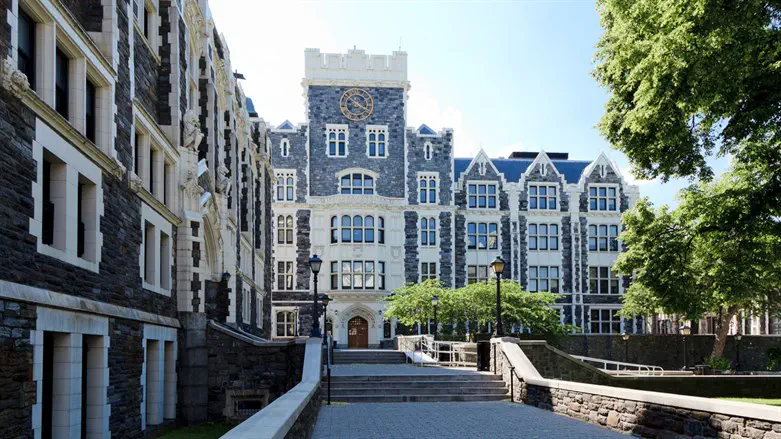
New York’s only publicly funded law school is facing sharp criticism after a student group announced plans to host an event portraying Hamas’s vast terror tunnel network as a form of “decolonial land use."
The event, titled “The Underground in Gaza," is scheduled for March 4 in the community room at the City University of New York School of Law in Manhattan. It is being organized by the campus chapter of Students for Justice in Palestine, a national network that has played a prominent role in anti-Israel protests since the outbreak of the Gaza war in October 2023.
According to promotional materials, the talk will be delivered by Columbia University anthropologist Hadeel Assali and will examine “the history and usage of tunnels in Gaza, focusing on land use and social organization in resistance to colonization." The description frames the underground network built by Hamas as an example of “decolonial" practice.
For many observers, that characterization amounts to an academic whitewashing of terror infrastructure used to carry out attacks against Israeli civilians and soldiers.
Hamas, which is designated as a terrorist organization by the US, constructed an extensive web of tunnels beneath densely populated areas of Gaza over more than a decade. Israeli officials have long argued that the project diverted vast sums of money and construction materials away from civilian development. Instead of building schools, hospitals and bomb shelters for its own population, Hamas invested in underground passageways used to move fighters, store weapons and plan assaults.
The tunnels were also central to Hamas’s October 2023 invasion of Israel, during which terrorists murdered some 1,200 people and abducted hundreds more. Hostages were taken into Gaza and held in subterranean conditions. Israeli authorities and former captives have described severe abuse in the tunnels, including starvation, torture and sexual violence. Some hostages were executed underground.
Critics say that describing this network as “resistance" ignores its human toll and the strategic decision by Hamas to embed military assets within civilian neighborhoods. The presence of tunnel shafts and command centers beneath homes, mosques and schools contributed to the intensity of fighting in Gaza, as Israeli forces sought to dismantle the infrastructure while attempting to minimize civilian casualties. Hamas did not permit Gaza’s civilians to shelter in the tunnels it built.
Assali, who teaches at Columbia’s Center for Science and Society and offers a course called “Science Underground," has written about the tunnel system in academic and public forums. In 2024, she described the underground network as “a space that evades colonial capture," and referred to tunnels as “an essential form of resistance in Palestine," without explicitly naming Hamas.
Her academic work is influenced by the “settler-colonial" framework, an increasingly common lens in some humanities and social science departments. Proponents use it to describe Israel as a foreign implant. Critics argue that the paradigm erases the Jewish people’s millennia-old connection to the land of Israel and overlooks the fact that many Jewish Israelis are descendants of refugees who fled persecution in Europe and the Middle East.
The controversy has also drawn attention to the broader climate at CUNY Law. The school has faced scrutiny in recent years for inflammatory commencement speeches and activist legal initiatives tied to hardline anti-Zionist groups. Graduates of the institution frequently move into public sector legal roles across New York City, including as public defenders and nonprofit attorneys.
A spokesperson for the law school said it is “committed to open dialogue, academic freedom, and free speech," and emphasized that student-organized events do not reflect the official views of the school or the wider CUNY system.
Israel’s consul general in New York, Ofir Akunis, has called for the event to be canceled, arguing that presenting Hamas’s tunnel network as legitimate resistance “constitutes the normalization of terror and crosses a moral red line."
For many Jewish students and supporters of Israel, the episode underscores a growing concern: that in some academic spaces, the language of decolonization is being used to sanitize or justify violence against the Jewish state. They argue that robust debate about Israeli policy is legitimate and necessary - but that reframing a terror group’s underground war machine as innovative land use crosses from critique into moral inversion.