

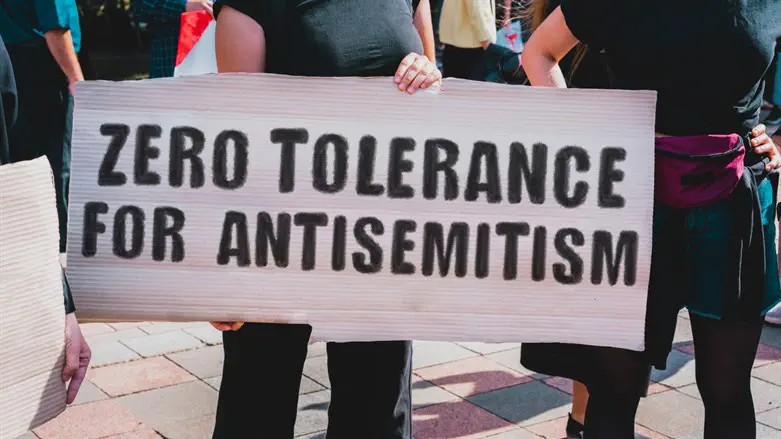
The American Jewish Committee’s (AJC) State of Antisemitism in America 2025 Report found that the vast majority (91%) of American Jews say they feel less safe as a Jewish person in the United States.
The survey investigated American Jews' feeling of safety following the arson attack during Passover on the Pennsylvania Governor’s residence, the murders of Sarah Milgrim and Yaron Lischinsky outside the Capital Jewish Museum following an AJC event, and the firebombing of a Boulder, CO, march in support of the hostages held by Hamas in Gaza.
“We need Americans to wake up to the reality of what their Jewish neighbors are experiencing," said AJC CEO Ted Deutch. “Right now, in America, when Jews gather, whether at synagogue or a community event, it’s routinely behind metal detectors and armed guards. No one in America should have to change their behavior because of what they believe, but that’s how most Jews are living their lives. What we’re asking for is what every other minority group expects in America: the freedom to be who we are without fearing for our safety."
While the arson attack in Pennsylvania and deadly attacks in D.C. and Colorado were among the most violent examples of antisemitism over the last 12 months, they were not isolated incidents - 86% of American Jews say antisemitism has increased in the two years following the October 7, 2023, Hamas terrorist attacks on Israel.
Much of this antisemitism has been seen online, with 73% of American Jews experiencing antisemitism online - either by seeing or hearing it or by being personally targeted, the first time this number has risen above seven in 10 in the history of AJC’s State of Antisemitism in America Report. Amid the proliferation of the use of generative AI chatbots like Grok, ChatGPT, and Claude, 65% of American Jews say they are either very or somewhat concerned that these applications will spread antisemitism.
The rise of antisemitism is having a profound impact on how American Jews are living their everyday lives. More than half (55%) of American Jews say they changed their behavior in the past year out of fear of antisemitism - and for the 31% of American Jews who report being the target of antisemitism - in person or virtually - in the last year, eight in 10 (80%) changed their behavior. In addition, 17% of American Jews report that they have considered leaving the country due to antisemitism in the past five years, up from 13% in 2024.
Safety and Security
AJC released the first State of Antisemitism in America Report in 2019, one year after the 2018 Tree of Life shooting, the deadliest antisemitic attack in US history. In 2019, 42% of American Jews said that the status of Jews in the US was less secure than a year ago. In 2025, two-thirds of American Jews (66%) surveyed report that Jews in the US are less secure than a year ago.
Thirty-one percent of American Jews report being the target of antisemitism at least once over the last year with the experience among young American Jews, between the ages of 18 and 29, more concerning. Nearly half (47%) of young American Jews say they were the personal target of antisemitism in the last year, compared to 28% for those age 30 and over.
Over a quarter - 27% - of young American Jews report being the target of an antisemitic remark in person, compared to 20% age 30 and over; 29% say they were the target of an antisemitic remark or post online or through social media, compared to 18% age 30 and over; 11% say they were the victim of antisemitic vandalism, or messaging (such as flyers or pamphlets) left on their personal property, compared to 4% age 30 and over; and 7% say they were the target of a physical antisemitic attack, compared to 2% age 30 and over.
Twenty-eight percent of American Jews report that at least one of the Jewish institutions that they are affiliated with - such as synagogues, Jewish schools, JCCs, and Jewish Federations - were the target of antisemitic incidents in the last five years.
Online Antisemitism Hits Record Numbers: Big Jumps on Facebook, Instagram, and YouTube
The same year that social media platforms altered their approach to moderating harmful content, American Jews reporting seeing or hearing antisemitism online increased. Seventy-one percent of American Jews reported seeing or hearing antisemitism online or on social media in the last 12 months - compared with 67% in 2024, and 19% have been personally targeted by an antisemitic remark or post online or on social media. The problem is even more prevalent among Jews under 30 years old, with 29% having been the target of a remark or post on social media. Forty-five percent of the US adult general public report seeing or hearing antisemitism in the last 12 months, of this group the vast majority (74%) say they saw or heard it online or on social media.
In all, nearly three-fourths (73%) of American Jews experienced antisemitism online - either by seeing or hearing it or by being personally targeted. This group reported noticeable jumps in incidents on Facebook, Instagram, YouTube, and TikTok. When asked where online they experienced antisemitic content:
- 54% report seeing or hearing it on Facebook, a seven-point rise from 47% in 2024;
- 38% report seeing or hearing it on YouTube, an 11-point increase from 27% in 2024;
- 40% report seeing or hearing it on Instagram, an eight-point increase from 32% in 2024, and
- 23% report seeing or hearing it on TikTok, a five-point increase from 18% in 2024.
Twenty-one percent of American Jews who experienced antisemitism online say they felt physically threatened by these incidents.
Rising Antisemitism is Changing How Jews Live
The vast majority (93%) of American Jews say antisemitism is a problem in the US today with more than half (55%) of American Jews reporting that they changed their behavior out of fear of antisemitism in the past year, with significant increases from pre-October 7, 2023, levels:
- 41% say they have avoided publicly wearing or displaying things that might identify them as a Jew, an 18-point increase from 23% in 2022;
- 39% say they have avoided posting content online that would identify them as a Jew or reveal their views on Jewish issues, a 12-point increase from 27% in 2022; and
- 30% say they have avoided certain places, events, or situations out of concern for their safety or comfort as a Jewish person, a 14-point increase from 16% in 2022.
For the 31% of American Jews who were the personal target of antisemitism, the impact was even greater, with eight in 10 (80%) reporting changing their behavior out of fear of antisemitism.
Seventeen percent of American Jews report that they have considered leaving the country due to antisemitism in the past five years. In another AJC survey, AJC’s 2024 Survey of American Jewish Opinion, released in June 2024, Jewish adults were asked a different, albeit related question: “Have you considered leaving the United States due to antisemitism to move to another country in the past five years prior to October 7?" At that time, only 6% of respondents said yes.
Nearly one in five (18%) American Jews say they have felt uncomfortable or unsafe in a social group or setting in the past 12 months and one in four (25%) American Jews say local businesses where they live were the targets of antisemitism in the past year.
Antisemitism on Campus
American Jewish college students - including current students and those who have been students in the past two years - continue to express concerns about antisemitism, with roughly four in 10 (42%) reporting experiencing antisemitism during their time in school. Critically, the vast majority (80%) of parents of Jewish high school students say that reports of antisemitism on campus are at least somewhat important in deciding where their student will attend college.
In 2024, 35% of Jewish college students reported experiencing antisemitism during their time in college, and 68% of parents of Jewish high school students said reports of antisemitism impacted their decision on where their student would attend school.
One in four (25%) Jewish college students say they have felt or had been excluded from a group or an event on campus because they are Jewish and 24% report the same because of their assumed or actual connection to Israel.
Protest Chants and Their Connection to Antisemitic Incidents
The vast majority of US Jews (88%) express that seeing or hearing “Globalize the Intifada" would make them feel unsafe as a Jewish person in the US to some degree - ranging from “not too unsafe" (19%) to “somewhat unsafe" (42%) to “very unsafe" (27%). By comparison, just 12% of US Jews say the phrase would not make them feel unsafe at all.
Seventy-three percent of the US general public say they have seen or heard the phrase “Free Palestine" in the past 12 months, 32% have seen or heard “From the River to the Sea, Palestine will be free," and 13% have seen or heard “Globalize the Intifada."
US adults who reported seeing or hearing each phrase were asked how much they had heard about that specific phrase being connected with antisemitic incidents. Among those who have seen or heard each phrase, 62% have seen or heard “Free Palestine" connected to antisemitic incidents, 68% have seen or heard “From the River to the Sea, Palestine Will Be Free" connected to antisemitic incidents, and 68% have seen or heard “Globalize the Intifada" connected to antisemitic incidents.
The shooter who murdered Sarah Milgrim and Yaron Lischinsky in Washington, D.C., is reported to have shouted “Free Palestine" during the shooting. The alleged attacker in Boulder, CO, is also reported to have yelled “Free Palestine" as he threw a Molotov cocktail at the crowd of people gathered to support hostages held by Hamas in Gaza, ultimately leading to the death of 82-year-old Karen Diamond.
Majority of American Jews Concerned About AI's Potential to Spread Antisemitism
According to a July 2025 AP-NORC poll, “[60%] percent of adults report ever using artificial intelligence (AI) to search for information." AJC’s State of Antisemitism in America 2025 Report found that 65% of American Jews say they were either very or somewhat concerned that generative AI chatbots such as Grok, ChatGPT, or Claude will spread antisemitism, and 69% say they are either very or somewhat concerned that information and misinformation shared by generative AI chatbots will lead to antisemitic incidents.
AJC’s report also found that nearly one in 10 (9%) of US adults have asked generative AI chatbots for information about Israel in the past 12 months.
Awareness Among the US General Population
In 2025, more Americans are noticing antisemitism. Forty-five percent of US adults reported personally seeing or hearing any antisemitic incidents, such as negative remarks or online content about Jewish people, or physical attacks on Jewish people or their religious facilities in the last 12 months, up from 39% in 2024 and 2023.
However, even with this increased awareness, there is still a large gap between American Jews (93%) and US adults (70%) who think that antisemitism is a problem in the US today. This disparity is even larger among those under 30 years old, with 93% of young Jews and 61% of young Americans thinking that antisemitism is a problem.
This discrepancy also exists among American Jews (86%) and US adults (63%) who say antisemitism has increased in the US following the October 7, 2023, Hamas terrorist attacks.
Recognition of antisemitism is higher among adults who personally know a Jewish person. Fifty-four percent of US adults who know a Jewish person report personally seeing or hearing any antisemitic incidents over the last 12 months compared to only 32% of US adults who do not know a Jewish person.
US adults who personally know a Jewish person are also more likely to have heard the term antisemitism and know what it means (81% vs. 51%) and to say that antisemitism is a very or somewhat serious problem in the United States today (75% vs. 62%).
Implications for American Policy and Democracy
Across the modern era, historians and social scientists have identified recurring patterns in which surges in antisemitism align with broader polarization and division, and threats to democratic norms. In 2025, a majority of both American Jews (77%) and US adults (64%) say they have less trust in the way democracy is functioning in the US as compared with five years ago.
The impact of antisemitism is not limited to the Jewish community. AJC’s State of Antisemitism in America 2024 Report shared that 90% of US adults said antisemitism affects society as a whole and everyone is responsible for combating it.
“Antisemitism is never an isolated problem - it is both a warning sign and a catalyst of deeper societal breakdown," said Holly Huffnagle, AJC’s Director of Antisemitism Policy. “When hatred toward Jews is allowed to spread, it corrodes social trust, legitimizes extremism, and weakens the democratic institutions that protect everyone, making a clear, dedicated government response not just optional, but necessary."
While the US currently has a Special Envoy to Monitor and Combat Antisemitism, the focus of this office is global and not domestic. AJC, the global advocacy organization for the Jewish people, has long understood the importance of this role, and both contributed to and supported the bipartisan Global Antisemitism Review Act of 2004, which first established the position, as well as the Special Envoy to Monitor and Combat Antisemitism Act, which elevated this role to the rank of Ambassador and strengthened its position within the US Department of State.
AJC is once again calling for the creation of a position focused on countering antisemitism in the US This was among the recommendations AJC put forth in AJC’s first Call to Action Against Antisemitism in America and was also included in the US National Strategy to Counter Antisemitism. Sixty-six percent of American Jews believe it is at least somewhat important that the US government create a designated role for an official to focus on countering antisemitism in the US.
The surveys of American Jews and US adults were conducted for the nonpartisan American Jewish Committee by the independent research firm SSRS. The Jewish American survey collected data from a nationally representative sample of 1,222 Jews, ages 18 or older from September 26 - October 29, 2025. The US adult survey collected data from a nationally representative sample of 1,033 general population adults, 18 or older, from October 3 - October 5, 2025, via the SSRS Omnibus Opinion Panel. The margin of error for Jewish respondents is +/-3.7 percentage points and for total US adult respondents is +/-3.4 percentage points at the 95% confidence level. Two questions in the Jewish survey were re-asked following the initial field period. The margin of error for the re-asked questions is plus or minus 4.2 percentage points at the 95% confidence level.