
Amid deep disappointment in Iran over the decision by US President Donald Trump to freeze assistance to protesters and halt military action against the Iranian regime, Arutz Sheva spoke with Dr. Thamar Eilam-Gindin, an expert on Iran from the Ezri Center for Iran and Persian Gulf Studies at the University of Haifa.
At the outset of the interview, Dr. Eilam-Gindin questioned what practical benefit a belated US strike would bring. For the estimated 12,000 to 30,000 Iranians killed by regime forces, and for their families-many of whom do not even know where their loved ones are buried-such a move, she said, would come far too late to make a difference.
To illustrate her argument, Dr. Eilam-Gindin traced the sequence of events and highlighted the close connection between President Trump’s statements and the willingness of Iranian citizens to take to the streets and pay a heavy price. “The protests began on December 28. On the Friday of that week, Trump said he would not repeat what he described as Obama’s historic mistake, when protesters relied on US support that never came and 200 people were killed. He said he would not repeat that mistake, that he supported the protesters, and that if the regime began killing, he would intervene. The next morning, he demonstrated that he was capable of acting. With that tailwind, the Iranian people went out into the streets."
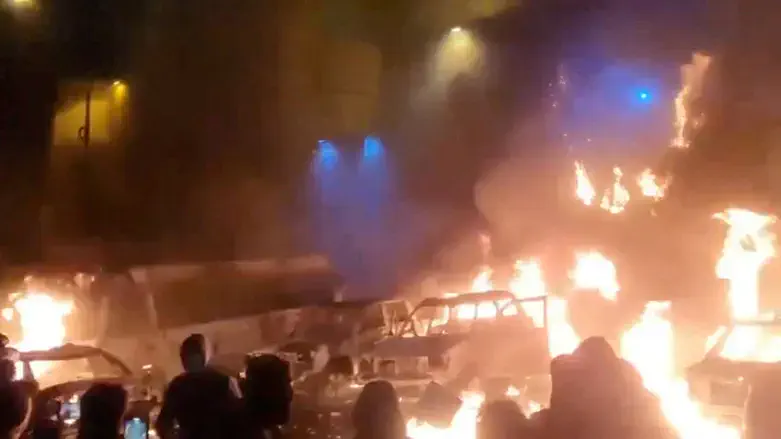
She noted that during the initial weeks, protests did erupt in various locations across Iran, but typically involved only dozens or hundreds of demonstrators. That changed dramatically on Thursday, January 8. “With Trump’s backing and in response to a call by Crown Prince Reza Pahlavi, a million-and perhaps millions-took to the streets. It was far larger than anything seen before, and actions were taken that had not occurred in previous protest waves. In earlier protests, demonstrators burned Basij and police stations. This time, in Tehran alone, 25 mosques were burned, out of a total of 350 nationwide. Sixty bank branches and fifty fire trucks were also burned in Tehran."
“Most of the fatalities-more than 10,000-occurred during the night between January 5 and 6, not over the entire period of the protests," she said. “Trump did nothing, and the internet was shut down." She expressed doubt that US bombing, even if it were to take place and even if it succeeded militarily, would provide a solution. Such action, she argued, might eliminate certain regime figures only to see others rise in their place. What is required, she said, is the uprooting of the system itself-“something that requires sophistication, not just bombing."
According to Dr. Eilam-Gindin, President Trump made sweeping promises without fully considering their consequences. She suggested that had he immediately deployed an aircraft carrier to the region, his statements might have been taken more seriously by both the regime and the protesters.
“From the fall of Assad until these protests, the regime was in survival mode," she explained. “They no longer had Hezbollah forces available to send thousands of fighters to suppress demonstrations. They therefore believed that if the public took to the streets, it would be difficult to contain. This time, they brought Hashd al-Shaabi forces from Iraq, dispersing protests with battlefield weapons, including grenade launchers."
Dr. Eilam-Gindin also reported that internet access has begun to reopen slightly, but that as soon as limited access to Google became available, messages from the exiled crown prince appeared. Most websites, however, remain blocked. “There are 90 million Iranians, and events unfolded differently in every city, so the information emerging varies from place to place. Medical personnel report that wounded protesters are being arrested by security forces, which have also carried out executions on the spot-something that did not happen previously. At the same time, some say the killings have not frightened them, but have instead made them angrier and more determined."
She added that President Trump’s claim that he had saved 800 people from execution was unfounded. “This is a joke," she said. “The entire senior judiciary has stated not only that executions are not being canceled, but that detainees are being sent to trial with verdicts already prepared, so the process will not take years. Charges have already been decided, and they intend to act more quickly. When Trump speaks of a diplomatic solution, it grants legitimacy. The result is that instead of being shot in the streets, people are hanged in prisons at the call of the muezzin at dawn. It has not saved anyone."