
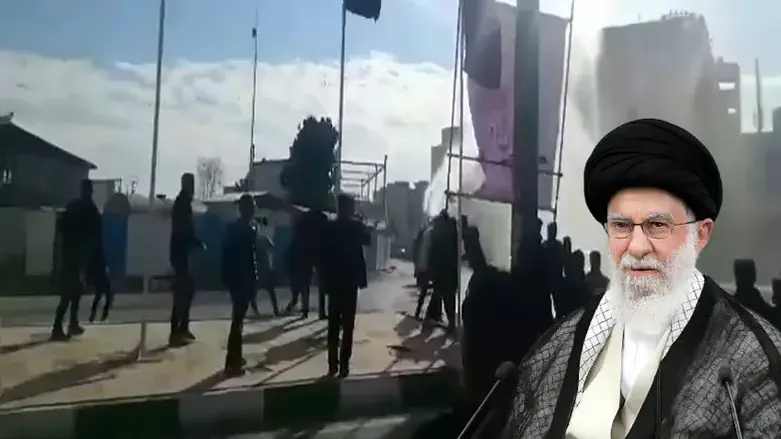
Arutz Sheva - Israel National News spoke with Dr. Yehuda Balanga of Bar-Ilan University’s Department of Middle Eastern Studies about U.S. deliberations over potential actions that could threaten the ayatollahs’ rule in Iran.
According to Dr. Balanga, U.S. President Donald Trump’s intentions are difficult to discern, as his statements often contradict one another. “On the one hand, he says Iran has crossed a red line; on the other, he claims the Iranians have sent messages expressing willingness to negotiate a new nuclear agreement," Balanga explained. “He says the U.S. will intervene but will not deploy ground forces. Whether this points to a move similar to what occurred in Venezuela under Maduro remains unclear."
Balanga noted that the United States maintains extensive military capabilities in the Middle East - by air, land, and sea - but the key question is Washington’s objective. Targeting Iran’s economic assets could damage the global economy, something Trump, as a businessman, would likely seek to avoid. Similarly, a ground invasion is improbable given Trump’s repeated emphasis on ending wars rather than starting new ones. Instead, Balanga suggested the possibility of limited technological strikes - such as drone attacks - against regime infrastructure or symbols of authority, potentially easing pressure on protesters confronting Iranian security forces.
When asked about Israel’s role, Balanga said that while speculation persists about another confrontation involving Lebanon, such a scenario is unlikely as long as diplomatic signals continue between Washington and Tehran.
Balanga also urged caution in assessing the scale of Iran’s internal unrest. While demonstrations have been widespread, Iran’s population exceeds 90 million, and the number of protesters must be viewed in proportion. He contrasted the current situation with Egypt’s Tahrir Square uprising, where millions mobilized and sustained their presence, eventually prompting U.S. support for President Hosni Mubarak’s resignation. A similar mass movement later forced Mohamed Morsi from power. Only such overwhelming public mobilization - combined with defections or neutrality within the military and security forces - could prompt the United States to openly back regime change in Iran.
Another option available to Washington, Balanga said, would be indirect involvement. “The Americans are very skilled at this," he noted, referencing historical precedents in South America and the Middle East during the 1950s and 1960s, including support for militias or revolutionary elements to intensify unrest.
Balanga added that fear of direct confrontation with Iran also factors into U.S. decision-making. Since protests began, Iranian officials have issued threats against the U.S. and its allies. With major American military installations in Qatar and additional bases in Bahrain, Kuwait, Saudi Arabia, and the UAE, these threats are taken seriously. “Iran has threatened to target American or allied infrastructure," Balanga said, noting that such warnings concern Gulf leaders, who have sought assurances from Washington.
Still, Balanga argued that recent Israeli military actions against Hezbollah and Iranian targets have demonstrated that threats do not always translate into action. He described Iran’s posture as increasingly weak, citing unemployment, drought, water shortages, and power outages. “Given Iran’s current condition, it is doubtful it has the capacity to launch large-scale operations against Arab armies or U.S. forces," he said.
Balanga cautioned against expecting a swift resolution. He recalled that the fall of the Shah took roughly a year and that many regime changes unfold gradually. He also referenced predictions that Syrian President Bashar al-Assad would fall within weeks - forecasts that proved incorrect more than a decade later. For that reason, Balanga advised restraint and patience when assessing Iran’s future.