

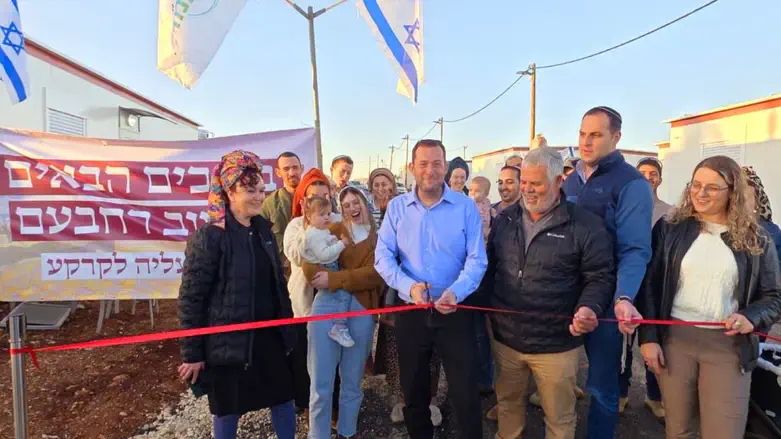
The new community of Rehavam was officially inaugurated on Sunday, following a government decision to establish 22 new towns in Judea and Samaria.
Located near Migdalim, Rehavam was launched in a festive ceremony attended by 10 pioneering families who were the first to settle the site. Also present were Samaria governor Yossi Dagan and representatives of the Amana movement, which partnered in advancing the project.
The establishment of Rehavam marks another milestone in the initiative led by Dagan to bring one million new residents to Samaria. Developed over approximately a year and a half with the support of professional planning teams, the initiative aims to expand construction, establish new communities, and strengthen the region’s long-term future. A central goal of the plan is the creation of additional towns and communities throughout Samaria.
Finance Minister and Defense Ministry Minister Bezalel Smotrich sent a message of support for the project, stating that efforts are being made to ensure that government decisions regarding construction and regulation are translated into concrete action. He emphasized the investment of significant resources and thanked partners in the Settlement Administration, the Civil Administration, and Samaria Regional Council for their cooperation. Smotrich said the government would continue to strengthen Israel’s presence in Judea and Samaria and enhance security in the area.
Speaking at the ceremony, Dagan described the establishment of Rehavam as part of a broader national effort, carried out despite the challenges of the ongoing war. He said the Samaria Regional Council is acting according to a structured plan that includes identifying useable land, founding communities and farms, and working toward the goal of reaching one million residents in Samaria under full sovereignty.
Dagan also noted that the new community is named after Rehavam Ze’evi, whom he described as a key figure in early post-Six-Day War planning for Jewish settlement in Judea, Samaria, and Gaza. He said the current construction efforts are based in part on plans Ze’evi developed and praised the pioneering families who chose to settle the area.
Chananya Nahaliel of the Amana movement said that in his three decades of involvement in construction, he could not recall a period marked by such momentum. He added that unified efforts lead to significant achievements and described construction as a key component of security. Some of the new residents of the town stated that they were excited to help the region grow and expressed a desire to see Rehavam develop into a large and close-knit community.