

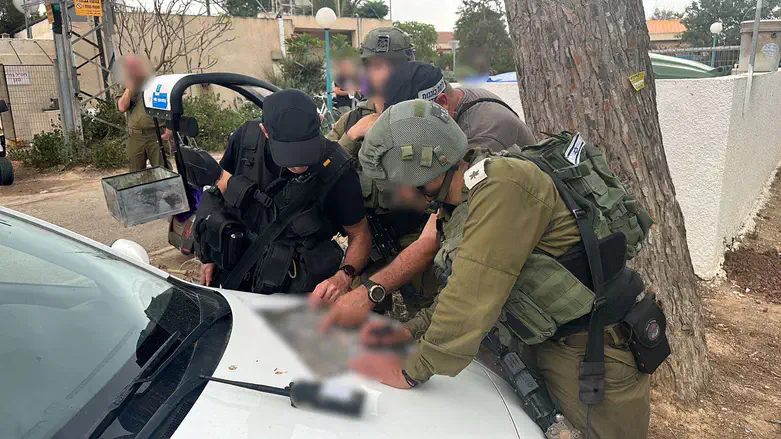
At the close of 2025, the line between Israel’s home front and the battlefield became increasingly blurred. Speaking with Israel National News - Arutz Sheva, Maj. M., deputy commander of the Shahar Battalion in the Home Front Command’s Rescue Brigade, described a year defined by constant operational readiness and an unwavering sense of mission.
For Maj. M. and his battalion, the past year centered largely on the Judea sector, where they carried out intensive and prolonged operational activity. “We’ve been deployed in the Judea Brigade for about ten months, holding an active operational line," he said. During this period, the battalion conducted hundreds of actions against Palestinian terrorist infrastructure, with a particular focus on Hamas operatives in the Hebron area. These missions included the arrest of wanted suspects, the seizure of weapons, and the confiscation of large sums of terror funds.
What sets the Shahar Battalion apart, however, is its ability to shift instantly from one operational world to another. During the campaign, when the Israeli home front came under missile fire from Iran, the battalion was required to leave its counterterrorism missions in Judea and Samaria and redeploy within hours to missile impact sites in southern cities. “It just happens," Maj. M. explained. “You drop everything, another force replaces you, and we jump straight into our operational arena to carry out rescue missions in Ashdod and Be’er Sheva."
This transition-from offensive counterterrorism operations to life-saving rescue under fire-demands exceptional mental flexibility. “It’s a complete change of phase," he said. “We tell our soldiers all the time: one moment you’re operating to neutralize terrorists, and the next you’re in rescue mode, focused entirely on saving lives beneath the rubble."
According to Maj. M., extensive training prepared the battalion for such scenarios, so the scale of destruction caused by missile strikes did not come as a surprise. Yet one moment defied all preparation: October 7. That morning, he found himself amid the horrors in communities surrounding Gaza, carrying out rescue missions unlike anything taught in Home Front Command courses. These were not extractions from collapsed buildings, but evacuations of families under live terrorist fire. “We weren’t prepared for that," he admitted. “In Be’eri and Magen, we rescued families under fire. It was a kind of mission we didn’t know-but we performed it well."
Asked what drives him to continue leading in such exhausting and dangerous conditions, Maj. M. speaks of a mission that goes far beyond the narrow military sense. “First and foremost, the mission," he said. “You understand you’re part of something far greater than yourself. And you know that if you don’t do it, no one else will."
Rooted in his religious and Zionist values, Maj. M. draws strength from his connection to the land and his faith in the justice of the cause. “I love this country and my roots," he said. “Everything we do is part of fulfilling a divine charge within a vast system that has a profound impact."