
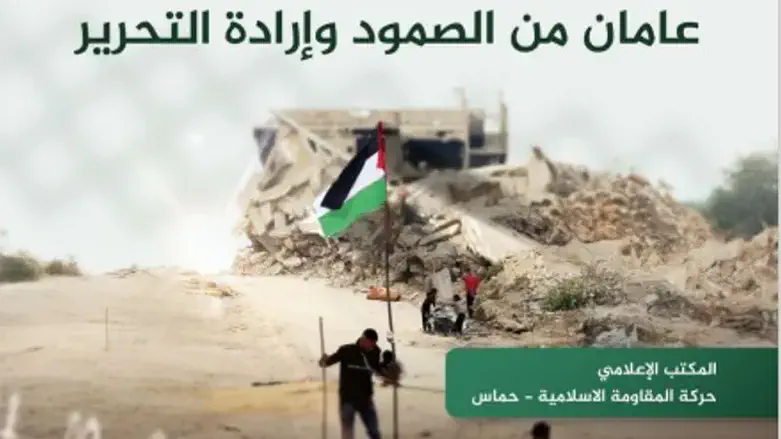
A Hamas internal document outlining the group’s lessons from the Swords or Iron war and its future plans - including intentions regarding Judea and Samaria - has been uncovered in recent days. The document was exposed by the organization Ad Kan and the Reservists Generation of Victory movement, which located it on Hamas-affiliated social media channels.
Gilad Ach, chairman of Ad Kan, said the document was distributed internally to the Izz ad-Din al-Qassam Brigades and summarizes roughly two years of fighting while setting strategic goals for the future.
“The document reached us through Ad Kan’s research department. It was published for the Al-Qassam Brigades and reflects two years of combat experience alongside future objectives,” Ach said. “It shows their continued ability to communicate and organize. We believed Hamas had suffered a crippling blow, but the document suggests it still maintains a stable command structure, weapons capabilities, and readiness for further fighting. They do not view ‘Al-Aqsa Flood’ as a failure, but as a success - and as something that will happen again.”
According to Ach, the document characterizes the opening day of the war as a success, despite acknowledging that not all objectives were achieved. “They describe the outbreak of the war as ‘the glorious crossing day,’ claiming they succeeded in paralyzing Israel,” he said. “They argue that the next confrontation will involve multiple fronts - Judea and Samaria as well as Lebanon - and state their goal is to end the current war while still standing.”
The authors also cite what they describe as a significant political achievement: international pressure on Israel. “They claim they succeeded in turning Israel into a pariah state in much of the Western world, particularly in Europe, leading to boycotts and diplomatic isolation,” Ach said.
Addressing Hamas’s continued operational capabilities, Ach pointed to testimonies from released hostages. “The hostages reported that beneath Gaza exists a vast underground city - tunnels, rooms, multiple levels, and command-and-control centers - even beneath areas under IDF control,” he noted. “The Deir al-Balah area, which was not fully captured due to concerns about hostages, remained largely intact. From there, Hamas leaders can continue issuing orders.”
Regarding future plans, Ach said the document lays out a coordinated multi-front attack scenario. “They claim that if they were able to overrun southern Israel quickly with 3,000 Nukhba operatives and another 6,000 unaffiliated fighters, then next time they will do so simultaneously from Gaza, Judea and Samaria, and Lebanon,” he said. “In their words, that would guarantee Israel’s destruction.”
Ach added that such documents are not difficult to obtain. “This is material distributed among Gaza-based groups and accessible to Arabic speakers. It is information that often does not reach the Israeli public,” he said.
Summarizing the document’s implications, Ach warned that it challenges assumptions about the war’s outcome. “What emerges is a picture in which, while many believed the war was over and that Hamas had been decisively defeated, the objectives were not achieved,” he said. “The threat to the Gaza Envelope has not been removed, Hamas was not destroyed, and the next October 7 could be around the corner. This appears to be just another round. Hamas remains standing, and after several years of recovery - rebuilding tunnels and smuggling weapons - it will be ready again. Its goal remains unchanged, and its ideology has not been uprooted.”