

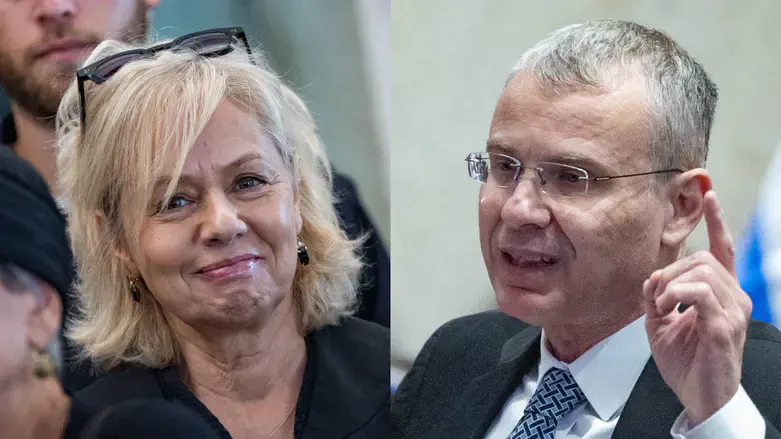
The Supreme Court has ruled that Justice Minister Yariv Levin is authorized to appoint an external candidate to oversee the investigation into the Military Advocate General (MAG) affair, but determined that the appointee will not be retired Judge Asher Kula.
The three-judge panel, which reviewed the petitions regarding who should supervise and monitor the police investigation, ruled that given the “exceptional and extreme circumstances” of the case, the Justice Minister acted within his authority when deciding to assign oversight of the investigation to an external figure-outside the Attorney General’s Office and the State Attorney’s Office.
However, the court clarified that the position cannot be assigned to the Commissioner for Public Complaints Against Judges, citing legal restrictions defining that office’s mandate.
Presiding Judge Yael Willner wrote: “Since the highest-ranking officials in the Attorney General’s Office and the State Attorney’s Office-including the Attorney General herself and the State Attorney-were involved in the events under investigation and may therefore be required to testify, and given the hierarchical relationship between them and other senior officials, there is no escaping the conclusion that under these exceptional and extreme circumstances, a limited and defined deviation from the rule against political involvement in criminal investigations is justified-despite the significant challenges it poses.”
She added that the minister’s decision does not constitute direct interference in a criminal investigation but rather “an indirect intervention, limited to the selection of the state employee to whom investigative oversight will be transferred, after which no further connection remains between the minister and that employee.”
Justice Alex Stein wrote that according to the Criminal Procedure Law, “the minister must appoint, at his discretion, a senior jurist with expertise in criminal law, free of personal interests and political influence-that is, someone whose overall qualifications closely resemble those of a senior state prosecutor.”
Justice Gila Canfy-Steinitz added that, “Since no thorough examination of conflicts of interest has been carried out that would allow senior prosecutors to oversee the investigation, and given the importance of ensuring an independent inquiry that maintains public confidence, the minister should be permitted to exercise his authority and assign oversight of the investigation to another state employee until the impediments are removed.”