

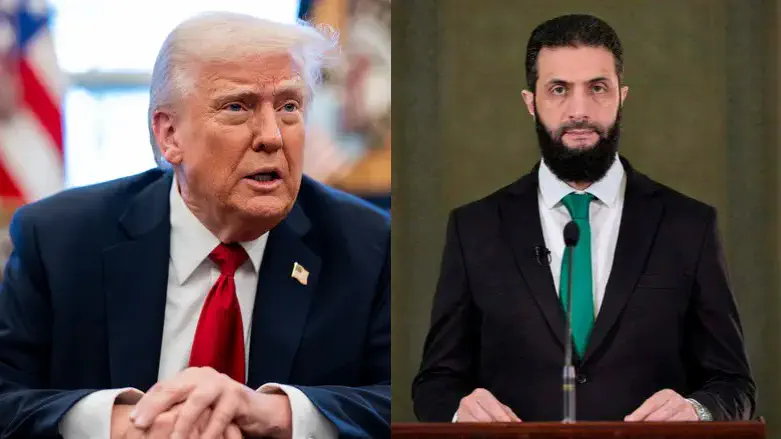
The White House confirmed Tuesday that US President Donald Trump will host Syrian President Ahmed al-Sharaa in Washington next week, marking the first-ever visit by a Syrian leader to the White House.
White House Press Secretary Karoline Leavitt said the meeting, scheduled for Monday, is part of President Trump’s broader effort to advance peace in the Middle East.
“When the President was in the Middle East, he made the historic decision to lift sanctions on Syria to give them a real chance at peace,” Leavitt said in response to a question by The National. “We’ve seen good progress on that front under their new leadership, and so he will be here at the White House on Monday.”
Syrian officials said over the weekend that the meeting will focus on postwar reconstruction and easing remaining sanctions on Damascus. The visit signals a potential thaw in relations between Washington and Damascus after more than a decade of isolation.
Since taking power from Bashar Al-Assad last December, al-Sharaa has embarked on a series of foreign visits aimed at restoring Syria’s ties with global powers that distanced themselves during Assad’s rule.
Al-Sharaa, who once led Syria’s Al-Qaeda offshoot, broke away from the network a decade ago and later clashed with ISIS forces. The US-led coalition drove Islamic State from its final Syrian stronghold in 2019, but the group has attempted to regroup following Assad’s fall.
In May, the Trump administration began lifting longstanding economic sanctions on Syria following al-Sharaa’s pledges to cooperate in efforts against ISIS and reduce ties with Iran. In June, Trump signed an executive order formally revoking the sanctions program, opening the door for renewed trade and reconstruction.
However, restrictions remain in place on individuals linked to the Assad regime, terrorism, and human rights abuses, including legislative measures such as the Caesar Act.
Leavitt declined to confirm reports that al-Sharaa may sign an agreement to join the US-led coalition against ISIS. Such a move would represent a dramatic shift for a country long considered a pariah by Washington.