

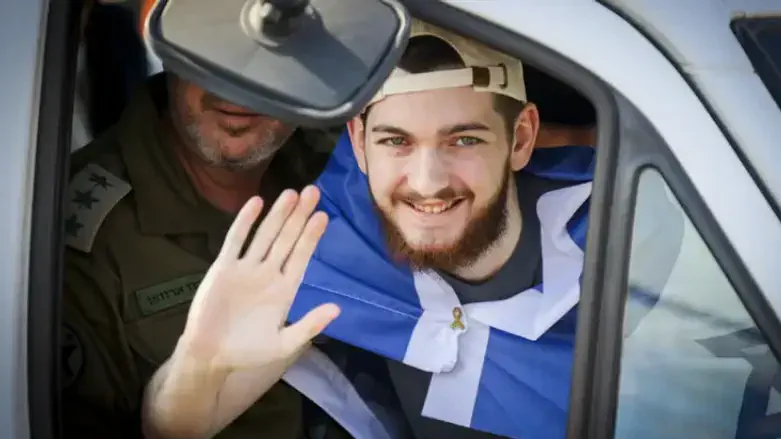
Julie Kuperstein, the mother of Bar Kuperstein - one of the hostages recently released - spoke with Galei Tzahal about the horrific ordeal her son endured during his time in captivity.
Describing the conditions as brutal and inhumane, Julie recounted the physical and psychological torture her son faced. “They were subjected to severe abuse - real torture,” she said. “The starvation was unbearable. You don’t treat human beings like that.” According to her, Bar shared with her, “They beat me, but I couldn’t feel it - my body was numb.” She explained that he trained himself mentally to dissociate from the pain. “It was all in his head. That’s how he survived,” she said.
Bar was held alongside several other hostages. Julie described the profound connection that developed between the families of the captives. “We truly became one family. When our loved ones came back and saw how united we were - it was a gift to them,” she said.
She also recounted how the captors communicated through flashing lights, signaling when food might be delivered. If no food arrived at that time, it often meant there would be none that day. “Bar told me, ‘Mom, I got used to living with very little food,’” she said. “When your stomach hurts and there’s nothing to eat - those are incredibly difficult moments.”
Julie said the hostages suffered further abuse whenever there was a Hamas casualty or damage to the homes of the captors’ relatives. “They would come and beat them, abuse them. It was very hard. I’d rather not go into the details,” she said. Bar coped by sleeping as much as possible. “That’s what kept him sane,” she added.
Despite the horrific conditions, Julie emphasized Bar’s compassion and resourcefulness. “He has hands of gold,” she said. “Even in captivity, he helped others - fixing electricity, repairing a latrine, channeling water, and even creating a small private area in the tunnel where others could go when they needed space.”
Julie also shared a miraculous moment when Bar was spared from an explosion. “They moved through several houses. The last one they stayed in was blown up. He wasn’t supposed to be there - it was a real miracle,” she said. During his captivity, Bar decided to donate the 200 shekels left in his wallet at home as an act of charity, believing it might help save him.
The family also had to hide Bar’s background as a Nahal soldier. He told his captors he was a medic. “He said it didn’t matter to them whether someone was a soldier or not - they treated everyone horribly,” Julie explained.
Julie noted that the experience deepened Bar’s spiritual connection. “When he returned, he asked for tzitzit. I was in shock,” she said. “He always had faith, was traditional - but not like this. He saw the Muslims praying and fasting and decided that he, too, wanted to draw closer to the Creator.” She added, “He said many Shema Yisrael, prayed, and recited Psalms. He had a dialogue with God.”