
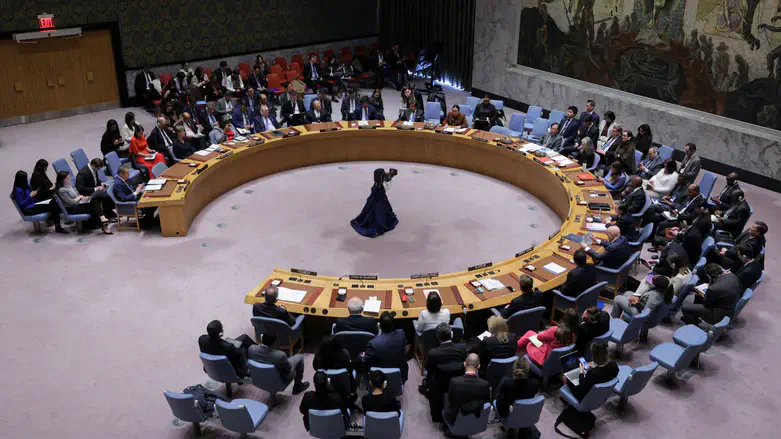
The United Nations Security Council on Friday failed to pass a resolution to prevent the reimposition of sanctions on Iran's rogue nuclear program, a move welcomed by Foreign Minister Gideon Sa'ar.
The resolution, which required the support of nine nations to pass, garnered only four votes, effectively allowing the "snapback mechanism" to be triggered by France, Germany, and the United Kingdom, according to The Associated Press.
The snapback mechanism, a key component of the 2015 Iran nuclear deal, automatically reinstates all UN sanctions that were in effect before the agreement was signed. These penalties include a conventional arms embargo, restrictions on ballistic missile development, asset freezes, and a ban on producing nuclear-related technology.
The vote comes several weeks after the E3 - Britain, France, and Germany - initiated a 30-day process at the end of August to trigger the "snapback mechanism".
Sa'ar was quick to praise Friday’s decision, stating, "Today, the UN Security Council voted to reinstate extensive sanctions on Iran, effective October 28."
Sa'ar emphasized the grave threat posed by a nuclear-armed Iran, adding, "Iran’s nuclear program is not intended for peaceful purposes. A nuclear-armed Iran would mean that the most dangerous regime possesses the most dangerous weapon, dramatically undermining global stability and security."
He concluded by underscoring the international community's duty, saying, "The international community’s goal must remain unchanged: to prevent Iran from ever acquiring nuclear capabilities."
The reimposition of sanctions threatens to escalate already high tensions between Iran and the West. While it's unclear how Iran will respond, its Foreign Ministry released a statement on Friday emphasizing its commitment to safeguarding its interests and rights, and said it reserves the right to "respond appropriately to any unlawful action."
Some Iranian officials have previously threatened to withdraw from the Nuclear Nonproliferation Treaty, following the path of North Korea, which abandoned the treaty in 2003 and later developed atomic weapons.
During the Security Council meeting, the four nations that supported the resolution - China, Russia, Pakistan, and Algeria - lambasted the European powers for what they called an "unjustified and illegal" action.
Russia's Ambassador to the UN, Vassily Nebenzia, said the Europeans were using the council as "a tool for their bad faith play, as a lever to exert pressure on the state in favor of a state which is trying to defend its sovereign interests." The Chinese envoy concurred, stating the council's action brought a "definitive" end to eight years of diplomacy with "one stroke."
Over the past several weeks, intensified diplomacy between Iran and the European countries has taken place, but without a resolution so far, sanctions were deemed likely.
(Israel National News' North American desk is keeping you updated until the start of Shabbat in New York. The time posted automatically on all Israel National News articles, however, is Israeli time.)