
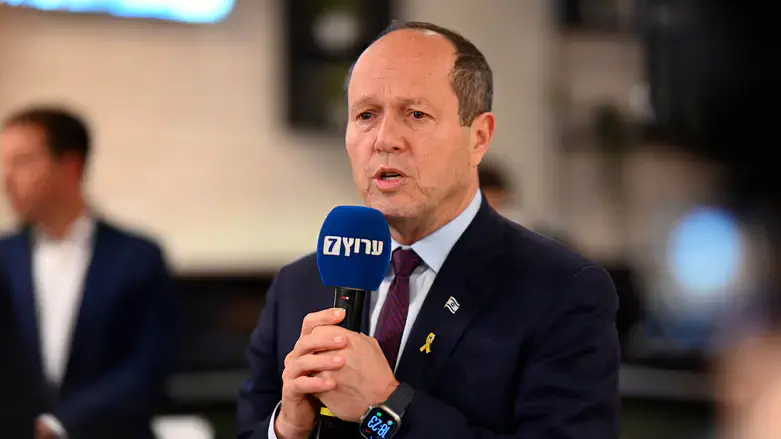
Economy and Industry Minister Nir Barkat views the “Emirates” framework proposed by Dr. Mordechai Kedar as a viable and proper political solution for Judea and Samaria.
Arutz Sheva sought to understand the practical implications of the idea, examine how feasible it is from a diplomatic and political standpoint, and assess whether it carries risks comparable to those of establishing a Palestinian state.
Minister Barkat stated: “This is a governance model based on tribes, which has proven to be the most successful model in the Arab world. Any attempt not to rely on tribes falls apart, which is what could have happened if the Palestinian Authority became a state. That’s why we believe the Emirates model is an excellent alternative to a Palestinian state that will never exist. The world asks what we support, and what we support is the Emirates model: a number of tribes spread across Judea and Samaria according to the model proposed by Dr. Mordechai Kedar.”
Barkat cites Hebron as an initial example for the plan, referencing recent statements by city leaders who seek to bring change to their lives. “The sheikhs in Hebron, the largest city in Judea and Samaria, are ready to pursue this model. We met with them; they want to leave the Palestinian Authority and join the Abraham Accords. They recognize Israel as the nation-state of the Jewish people, they fight alongside us against terror, and they want to return to the days before the First Intifada. This is a large city, and I am convinced that after success in Hebron, we will see other cities wanting to join this initiative.”
Regarding the challenge of the world understanding and accepting a tribal rather than state-based structure, Barkat described a meeting with five U.S. Congress members, including the Speaker of the House. After touring the Cave of the Patriarchs and learning about the Emirates model, they met the leading sheikhs of Hebron. Following hours of discussion, they concluded that the model is valid and feasible. In Barkat’s view, even if the world does not yet recognise or accept the model, American support could lead to a diplomatic shift.
We also asked Barkat about reports that immediately after the sheikhs publicly expressed their desire to separate from the PA, many voices in Hebron opposed the move. Barkat rejected this claim, asserting that the opponents are PA loyalists in Hebron. “The reason the PA harasses them and tries to obstruct them is because it understands that this threatens and undermines it. The sheikhs are significantly stronger than the PA—they are the majority, they have lived there for centuries, and they do not want to see the corrupt officials from Tunis. Most of Hebron’s security personnel are from the tribes,” Barkat said, emphasizing that these are people who want to be partners with Israel. “They do not see us as enemies but as future partners. The decision lies with Israel.”
Barkat noted that he is conducting discussions with the leaders of Israeli communities in Judea and Samaria to examine issues related to implementing the plan realistically. This includes questions of security, such as whether there will be fencing around the Emirates. “The initiative allows for the declaration of sovereignty over Judea and Samaria. The Arab residents understand where we are going. When I work on this with Zambish( Ze'ev Hever), Israel Gantz, Yossi Dagan, and others, we will guide them to manage their own affairs locally, while the State of Israel will manage other areas.”
When asked about the question of 'fencing' around the Emirates, Barkat said the Prime Minister will have to make decisions in complex negotiations, adding that “they want to move forward without preconditions. With goodwill and strong support from the national camp, we can reach agreements very quickly.”
Barkat stressed that “such a model is accepted in the Knesset not only by the national camp but more broadly, because even those who think differently understand that the Arabs themselves want an agreement that reflects their will, not imposed by Israel. This has a significant impact.”
Arutz Sheva also raised the concern that creating seven such Emirates could effectively mean establishing seven small Palestinian states instead of one, which could threaten Israel’s security. Barkat responded: “They do not expect that. They understand they will have their own police districts working with the Israel Police, while the army and Shin Bet will be responsible for security. They want to rely on Israeli infrastructure in health, employment, tourism, water, electricity, and more.”
“They do not have a nationalistic orientation. They want to remove Hamas and all what they define as ‘parties’ from the equation and create a unified police force that will coordinate with the Israel Police, as well as pursue normalization with Israel in other areas. They are not threatening us. They recognize Israel as the nation-state of the Jewish people.”
When asked what the main challenge of the initiative is , Barkat said it comes down to the questions of how and when. “Due to the complexity of additional challenges Israel faces, this is on the Prime Minister’s desk, and I trust him. My role is to prepare the groundwork, clarify certain issues, ensure consensus with my colleagues in government and with figures like Gantz and Dagan, make sure we speak the same language, and thankfully, this undermines the PA and shatters the two-state concept. I am very optimistic.”