
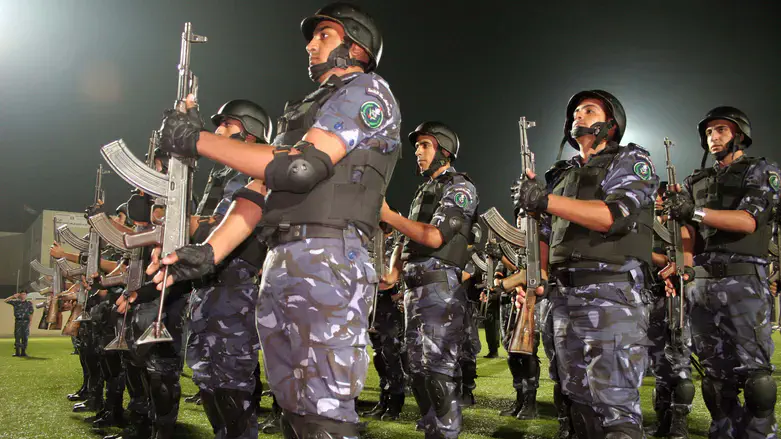
The Palestinian Authority (PA) recently concluded a three-day military exercise that has drawn renewed scrutiny in Israel. According to multiple reports, the drill included simulated raids, the takeover of towns by commando units, and the use of RPG launchers and advanced military equipment. The developments were discussed on Arutz Sheva-Israel National News with Brig. Gen. (res.) Amir Avivi, chairman of the Israel Defense and Security Forum, who warned that the exercise highlights a growing and dangerous trend.
Avivi cautioned that Israel is effectively fostering “an enemy army within the State of Israel,” calling the situation “very serious.” Recalling his own experience as a deputy brigade commander during violent clashes in the mid-1990s, shortly after the PA was established, Avivi said that weapons transferred to Palestinian forces were later used in heavy attacks in Judea and Samaria and Gaza. “We already saw the potential back in 1996,” he said, noting that Israeli casualties were sustained during those confrontations.
He acknowledged the extensive operations carried out by the IDF in the West Bank against Hamas and Islamic Jihad, which have significantly reduced their operational capabilities. In some cities, such as Nablus, Avivi said there are reportedly no remaining wanted terrorists. However, he stressed that large quantities of weapons remain in the field and are closely linked to the PA’s security forces, which he described as absorbing militants with an ideological commitment to Israel’s destruction. According to Avivi, this creates the risk of PA policemen one day turning their weapons against Israel.
Addressing the question of timing, Avivi pointed to the uncertainty surrounding the eventual departure of PA leader Mahmoud Abbas, who is in his 90s. “No one knows what the day after Abu Mazen will look like,” he said, warning that internal power struggles within the PA could spill over into violence directed at Israel. “Israel must prepare for this scenario,” he added.
While Avivi said the threat from Hamas and Islamic Jihad has been significantly reduced due to sustained Israeli operations, he argued that the PA is simultaneously growing stronger and enjoys a degree of legitimacy and partnership. As a result, he warned, Israel faces a shifting threat landscape in which attention may turn inward. According to Avivi, Iran’s broader regional strategy has been blunted, pushing Israel’s adversaries to focus on igniting unrest within Israel itself-combining elements in the Negev, Galilee, and mixed cities with what he described as the PA’s dangerous military potential, including large stockpiles of weapons and armored vehicles.
To counter this risk, Avivi said Israel must ensure that the PA does not possess capabilities beyond those of a civilian policing force. “There should be no RPGs or machine guns,” he said, arguing that such weapons must be confiscated and not tolerated. He also called for clear operational planning, enhanced intelligence monitoring, and preparation for possible escalation, noting that PA security forces include former prisoners and that some recent attacks were carried out by individuals affiliated with the Authority rather than Hamas or Islamic Jihad.
“These developments,” Avivi concluded, “are a warning sign that must be addressed before they turn into the next major campaign.”