
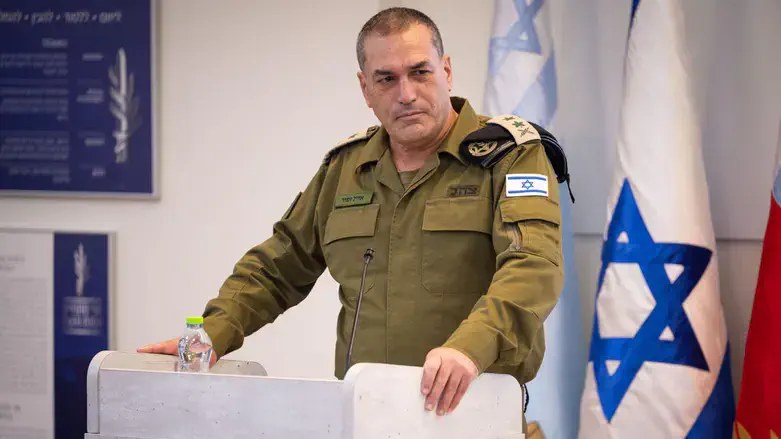
The Chief of the General Staff, LTG Eyal Zamir, held today (Monday) a General Staff situational assessment to evaluate the IDF’s operational preparedness. The assessment focused on addressing readiness challenges across the various arenas.
This was the second meeting in a series of situational assessments aimed at shaping the IDF’s annual work plan. Following the Chief of the General Staff’s directive, the meeting was expanded to include a broad forum of commanders, both from their respective headquarters and from on the ground.
Remarks by the Chief of the General Staff, LTG Eyal Zamir: “We must learn from the lessons of the past, continuously examine our preparedness, and from there improve, strengthen, and advance towards a strategic plan and a significant force build-up. Alongside this, our working assumption is that we are in a continuous war. The year 2026 will be a year of shaping and maximizing achievements, increasing preparedness, returning to fundamentals, and seizing operational opportunities."
"Since October 7th," he said, "the IDF has proven itself to be a quality military with multi-front combat capabilities. The IDF’s successes have changed the face of the Middle East, strengthened national security, and created regional opportunities that must be taken advantage of. The IDF is engaged in several active arenas, and we must maintain high readiness and preparedness at all times, for every arena."
"The IDF must return to fundamentals in procedures, alertness, training, and planning and force-build-up processes, while taking a differentiated approach to each arena and its characteristics. We must strengthen and expand the IDF by establishing new frameworks and reinforcing existing ones. All this must be based on the lessons of the war alongside a forward-looking perspective - operational and technological. We must continue to develop both the material — supplies, platforms, and means, and, above all, the spirit and resilience of the people, who are at the center of our work and attention," Zamir added.
He continued to say that, "in accordance with the Security Cabinet’s decision, we are at the beginning of a new stage of the combat in Gaza. We will develop the best method, in line with the defined objectives, while maintaining the professionalism and principles that guide our operations. We will do so with the readiness of the troops and weaponry, with the hostages at the forefront of our minds - we will do everything to protect their lives and bring them back home."
"The alternatives presented to the Security Cabinet - all are intended to defeat Hamas, with a full understanding of the implications in every aspect. The IDF will be able to achieve operational control of Gaza City, just as it did in Khan Yunis and Rafah. Our troops have conducted ground operations there before, and we will be able to do so again."
"We must allow breathing room for IDF troops in mandatory and reserve service, creating pauses that enable us to continue the ground operation in the Gaza Strip in the most effective and optimal way, while preserving strength for the future. The next situational assessment will focus solely on the people."
"We are still at war, and in the midst of it we are carrying out force build-up processes. This is an unprecedented situation. We must be prepared for an expansion of the campaign. I have immense appreciation for our people, in mandatory, career, and reserve service. I meet them everywhere and see their fighting spirit and determination. It is important to note the maintenance and combat support personnel across all branches, who are performing wonders in enabling the combat, they deserve every praise - the achievements of the war are thanks to them”.e Chief of the General Staff concluded the situational assessment by expressing his appreciation to the commanders who have been leading the IDF for nearly two years in the face of unprecedented multi-front challenges," LTG Zamir concluded.