

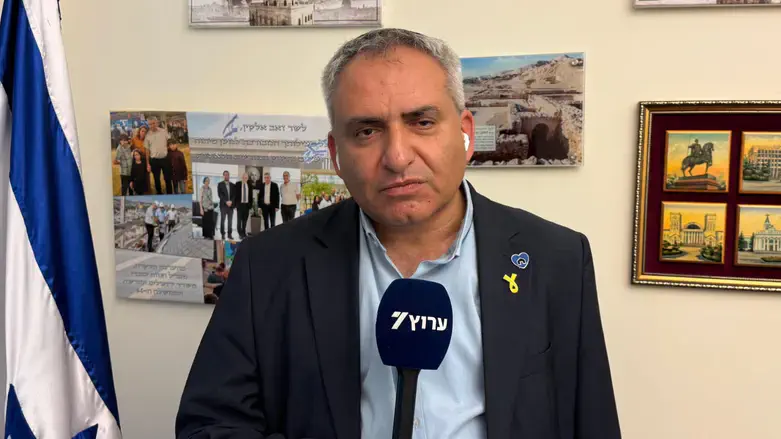
Minister Ze’ev Elkin, a member of the Security Cabinet, told Arutz Sheva-Israel National News on Wednesday that the recent successful military operation in Iran is expected to have a significant impact on Hamas in Gaza and its willingness to negotiate a hostage deal with Israel.
“There is dialogue, and there may be a breakthrough in the talks for releasing hostages, as Hamas is now much weaker than it was two weeks ago,” said Minister Elkin. “Hamas’s main supporter was Iran - it transferred funds and attempted to supply ammunition. Now that Iran has been severely hit and will need to focus on its recovery, its priorities will shift, and Hamas will no longer receive the same level of support. Moreover, the Iranian Revolutionary Guards official who managed relations with Hamas and the broader Palestinian Arab system has been eliminated.”
Elkin noted that this change may already be influencing negotiations. “It’s no surprise that hostage talks have resumed in recent days. We managed to reach two previous deals when we destabilized Hamas - first in Gaza when we surprised them at the start of the war by penetrating the heart of the Strip and capturing Shifa Hospital, and the second after a strike on Hezbollah, which revealed that Hamas's support network had collapsed. The severe blow Iran has now suffered could pave the way for a third agreement. We’ll know more in the coming days.”
Responding to comments made earlier by MK Moshe Gafni (United Torah Judaism), who questioned the purpose of the IDF’s continued operations in Gaza, Elkin replied, “I don’t understand why MK Gafni doesn’t grasp what we’re fighting for in Gaza. For me, the answer is very simple: to prevent another massacre like the one we suffered on October 7th. We’re fighting for the lives of all Israelis - including his. We must ensure that Hamas never again controls Gaza.”
Addressing the shifting focus of the IDF during the recent escalation with Iran, Elkin said, “Before the Iran campaign began, there was meaningful progress in Gaza. Over the past two weeks, much of our security apparatus was redirected to the Iranian front, a national effort aimed at literally saving the State of Israel from destruction. Now that the campaign is complete, we’re in a new strategic phase in Gaza. We’ll assess how hostage talks evolve and proceed accordingly.”
He emphasized the importance of air power now returning to Gaza: “Before the Iranian operation, we were operating in Gaza with immense firepower. Our Air Force is now able to return to assist in Gaza. If needed, air support will resume at full strength.”
“There is a price to waging war with Iran,” Elkin acknowledged. “When military resources are diverted, it impacts other fronts - there’s less initiative and fewer capabilities elsewhere. When we approved the Iranian operation in the Cabinet, we understood this would come at a cost in Gaza, just as there would be a cost on the home front. One of the lessons of October 7th is that if an enemy is preparing to strike at a time of its choosing, we must strike first - on our terms.”
Elkin also addressed the criticism voiced by US President Donald Trump following Israel’s response to Iran’s ceasefire violation. “I don’t think it was an outburst of anger; he simply has his own way of speaking. In general, he’s a very friendly President toward the State of Israel. There’s a close personal relationship between Prime Minister Netanyahu and President Trump, and between their respective teams.”
“Not only were we able to carry out the operation with prior coordination, but the US President made a historic decision to support our actions, even using advanced American technology to strike Iranian nuclear sites. While there may be tactical disagreements from time to time, we must remember we have a strong ally who stood firmly with us. In fact, our initial response plan was even more extensive, but we honored President Trump’s stance and coordinated accordingly.”
“In the end,” Elkin concluded, “this partnership is of immense strategic value. The world sees it - our enemies see it. With both defensive and offensive American support, Israel emerges from this campaign against Iran in a dramatically stronger position than it held just two weeks ago.”
Watch the Hebrew interview: