


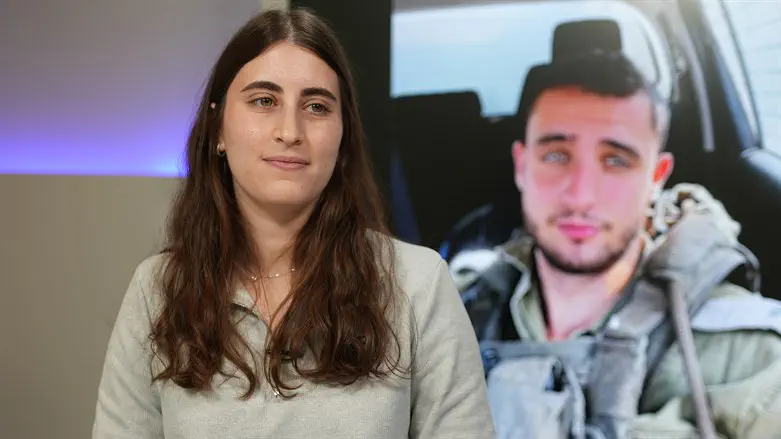
A week before the war broke out, Captian Kfir Franco, platoon commander in the 52nd Battalion, 401st Brigade, proposed to his girlfriend, Naama Dopelt.
At Franco's funeral, Naama recalled his marriage proposal, and told Israel National News - Arutz Sheva about her heartbreaking loss.
"You proposed to me opposite the walls of Jerusalem - you were like a wall for me, stability and an anchor," she mourned at his funeral. "It was so lucky that we managed before the war. We were so happy. You told me that this surprise would be the last surprise, because you can't keep secrets from me, but now you prepared a surprise for me, a last surprise."
Their wedding was to be held two weeks before the Passover holiday, on the first day of the month of Nissan: "Everything was almost set already, the only thing that remained was to ask his approval for the location and date. Almost everything was set."
On the morning of October 7, when Hamas brutally attacked Israel, Kfir went to the south, where he waited for instructions to enter Gaza.
"There was constant fear, even when he was in the area of the kibbutzes, on the staging grounds, my fear was not normal. After he went in, the fear was the same fear, maybe even greater, but without awareness, because we didn't know what was happening with him, and we could not speak," she said.
Kfir himself, however, "was like, 'dammit!'" she said. When he left home, he told his mother that he was going to fight a just war. She herself encouraged him to do his best, and stressed that they are relying on him to do so.
"It was important to give him encouragement from home, so that he would succeed and the feeling that we were afraid for him would not weaken him."
During the war, due to the uncertainty about what would happen in the future, the couple wondered whether they should use one of Kfir's leaves to get married: "He told me that it would be a long and difficult war, and that he didn't know when we would go out. I asked him if he would manage to be back by the wedding date, and he said that when he gets out, we'll get married. I wouldn't have minded getting married on the day he proposed to me."
"A wedding is something that needs to happen, it needs to be, and I am happy for the couples who made these weddings, because it shows the true importance of the wedding. It's not just a status," she said, referring to the last-minute weddings held by soldiers fighting in the field.
Kfir himself, she said, was "smiley, happy. You could see joy and life in his eyes. We would do a lot of silly things, a mature childish couple who could understand life but laugh and have fun. He was just good. The word 'good' takes on a whole new meaning when you're talking about Kfir."
Losing a fiance is "a different loss, it's a very difficult loss. It's a loss that's incomprehensible because we planned a life and a future together. You plan for someone to be eternal, and it's cut short. I find myself unable to see the future, beyond what we know will happen, G-d willing, that we will continue with Kfir's light. But in a physical sense, all the plans change, 180 degrees, and it's hard to digest that."
Regarding the position of the fiancees who are dealing with such difficult loss, Dopelt said, "It's a challenge. There are no laws of mourning which apply to us, but I chose to keep some of the laws of mourning for a family member. I took upon myself thirty days of mourning, I was present at the entire week of mourning, and they came to comfort me as Kfir's fiancee. HIs family is very supportive and embracing, I am like their daughter, just like I was supposed to be."
Israel has begun the process of recognizing bereaved fiancees, which Dopelt said is "a very important process. It's very critical. We were part of the lives of the soldiers who fell. Even if we hadn't been engaged, and we had been their girlfriends for a year or two, it's seeing a future together and building something certain - we are part of the family. I am Kfir's family and Kfir is my family, because we wanted to build something together. This is an important process and the embrace from the State is very significant, including for our continued struggle - to know that they are encouraging us, that they know we were something for him."
When asked how she wants people to memorialize Kfir, Dopelt said, "A love of the Land."
"He really loved the Land of Israel, and like I said many times, he believed that this path was just," she said. "We need to be there for our country. We will do everything they ask of us, even if it is difficult. They need us. It's not coincidence that people die for this country. We must believe in the Land of Israel, because we have no other place to be."
Dopelt also noted Kfir's smile, and called on people to continue to smile.
"He smiled in every situation, even when it was hard for him and when it wasn't good for him. He said, 'I am not crying over the past. We need to look forward and see how we can continue on,'" she recalled, noting that this is a message for herself personally during these difficult days - just as he told her during the moments of crisis she experienced while he was still alive.