

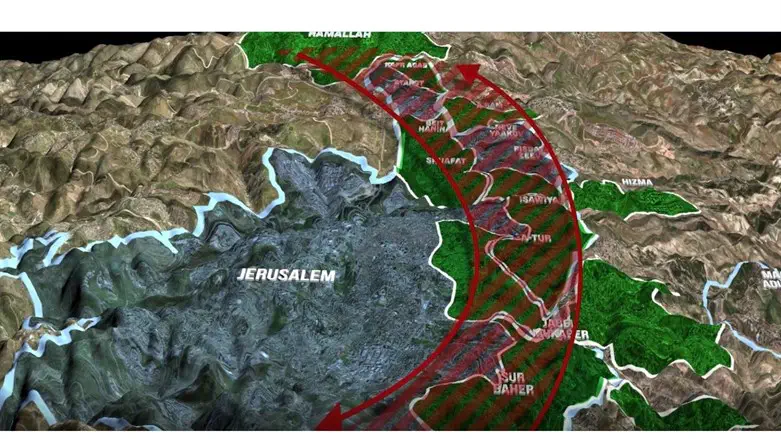
Among the many challenges facing the incoming government is Jerusalem, and the perceived loss of governance in the city. We talked about the challenge and its components with Maor Tzemach, chairman of the "Lach Yerushalayim" movement.
"The challenges in Jerusalem are on three different levels, social, political and security," says Tzemach. "On the political level, we submitted to a number of policy makers a document containing the necessary reforms to maintain the unity of Jerusalem and its sovereignty," he says.
"Jewish construction should be promoted in the face of the PA's desire to create an Arab continuum from Ramallah towards Bethlehem. To this end, the construction in the north of the city should be leveraged, with the establishment of the new and existing neighborhoods in the city's north. In addition, we must not overlook the necessity of strengthening Jewish construction in the Jerusalem suburbs. This connection is very important to work to promote construction in the E-1 area between Jerusalem and Maale Adumim. This is part of the need to break up the Arab territorial continuum that the PA is trying to create from north to south."
Tzemach also points out the need for an "uncompromising war against the illegal construction in areas C bordering the municipal territory of Jerusalem. Arab construction between Teko'a and Nokdim and Jerusalem can be a buffer between Jerusalem and the eastern Gush Etzion," he warns and emphasizes that Jerusalem cannot be left to deal with its limited municipal borders without the help of the surrounding towns when the belt of Arab settlement tightens in areas C adjacent to it.
Tzemach points out that even if it is clear that not every coalition demand will be realized immediately, and even if things will require a daily public struggle, then "we have a listening ear in the coalition, we have a listening ear in Ryeligious Zionism, and even within the Likud there are many with an open heart and a willing mind. This is an opportunity to preserve for generations the unity of Jerusalem," he states.
According to him, in order to achieve results even in the face of the difficult and violent reality in the east of the city, "it will be necessary to show determination and not compromise on every detail. The demand not to give the PA a foothold in Jerusalem is mandatory. The law needs to be amended," he says, noting the propaganda struggle against the activities of Sheikh Akrama Sabri. "The government must take responsibility for the Israeli schools in eastern Jerusalem, so that there will be no incitement there."
"The five-year plan is now ending. 2.5 billion shekels were poured into East Jerusalem, mainly for infrastructure and the education system. It did something, but not enough because some of the funds were not channeled correctly. We need to continue the five-year plan, with its 4.3 billion shekels, and plan well where these funds end up We need to invest in infrastructure, in strengthening Israeli elements in the eastern part of the city, and in strengthening systems with Israeli ties."
As for the social challenge facing Jerusalem's leadership, Tzemach emphasizes that since it is the capital of Israel, this challenge cannot be seen as a matter for the municipality alone, and the Israeli government must strengthen the social and economic fabric in the capital and create social resilience in it that will take it out of the lower economic and social deciles. "An economically and socially strong capital is also a significant capital in the political and security aspect as well."