

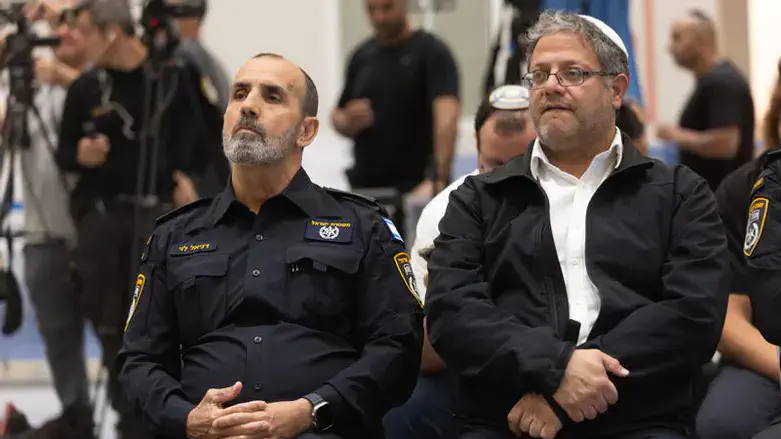
The dispute between National Security Minister Itamar Ben-Gvir and Israel Police Commissioner Danny Levy escalated on Sunday after the commissioner sent an unusual letter to Prime Minister Benjamin Netanyahu, requesting his urgent intervention following the minister's attempt to prevent him from attending the Interpol conference in Hong Kong.
Levy warned that undermining his standing as the Israel Police's official representative to the international organization could harm national security, the fight against crime, and the protection of security personnel.
The letter was sent after Ben-Gvir contacted Interpol directly and said the commissioner was not authorized to represent Israel at the conference. In his message to the organization, the minister wrote, "Police Commissioner Danny Levy does not represent Israel, and his participation in the conference must not be approved."
Levy, who traveled to Hong Kong despite the minister's opposition, asked Netanyahu to formally back the police delegation and clarify his standing as the Israel Police's professional representative to international officials.
Levy wrote to the prime minister, "I have no choice but to appeal to you to act urgently to support the delegation, for the sake of the security of the state and its citizens, while clarifying that the commissioner is the Israel Police's official professional representative in relations with its partners."
In his letter, the commissioner detailed the security and policing issues on the Israeli delegation's agenda at the conference. Among other things, he revealed that one of its main objectives is to try to block 26 international arrest warrants that Turkey is pursuing in connection with the flotillas.
According to Levy, Israel Police representatives at the conference are also working to prevent hostile countries from being elected to Interpol's Executive Committee and to strengthen international cooperation against criminal organizations.
"An outside appeal against the commissioner's participation, or any weakening of direct ties with Interpol and police forces around the world, harms our ability to protect our personnel and combat crime reaching Israel. This is true in general, and particularly in light of Iran's and Turkey's participation in the conference."
At the end of his appeal, Levy warned that if he were prevented from attending the conference, "there would be significant harm to internal security and to members of the security forces."
The commissioner did not limit his appeal to the prime minister. Copies of his letter were also sent to President Isaac Herzog, Foreign Minister Gideon Sa'ar, Attorney General Gali Baharav-Miara and National Security Council head Shmuel Ben Ezra.
The crisis between the two deepened after Levy decided to attend the Interpol conference even though Ben-Gvir had asked him to remain in Israel and had not approved his trip. The commissioner headed a police delegation that included the police spokesperson, his aide and other officers.
While Levy and the delegation were waiting to take off, Ben-Gvir sent his letter to Interpol asking that the commissioner be barred from participating in the conference. The minister's office argued that Levy's departure abroad violated procedures and that the security and crime situation in Israel required his presence in the country.
A statement issued on Ben-Gvir's behalf on Saturday said, "The police commissioner's trip abroad is not acceptable to the minister and was not approved by him as required by procedure." The statement also stressed that the commissioner had recently returned from a visit to Morocco, and that there was therefore no justification for another trip abroad at this time.
Meanwhile, with the commissioner abroad, Ben-Gvir announced on Sunday afternoon that he had approved 16 senior police officer appointments out of 185 awaiting his approval. The appointments had been delayed for an extended period amid the dispute between the minister and the commissioner. According to the report, Ben-Gvir had until now refrained from signing off on appointments and budgets, and had even said those matters would wait for the next minister.