
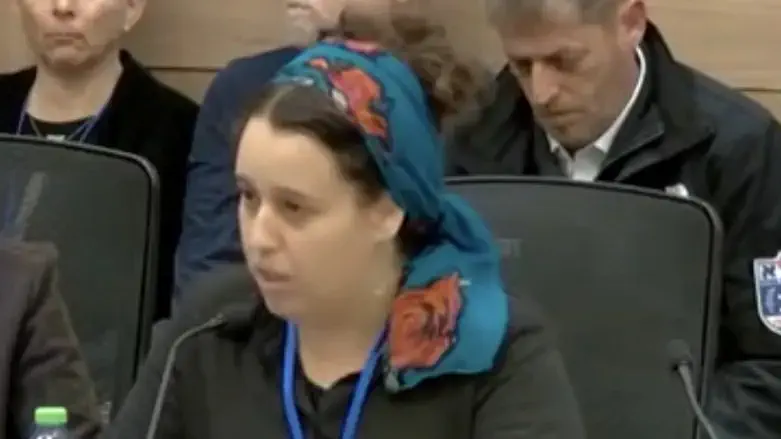
Hillel Granot Gruner, whose brother Capt. Amitay Granot was killed fighting Hezbollah, shouted at haredi protesters chanting, "We would rather die than enlist," telling them, "My brother really did die for you! How are you not ashamed?"
In her new book, The Most Immediate Need, co-written with Shvut Raanan and published by Yedioth Books, she revisits the moment when the anger she had accumulated over nearly two years of campaigning for haredi enlistment erupted, and the realization that led her to change direction.
"The physical presence of the people standing right before my eyes also intensified the anger and frustration they stirred in me," she writes at the beginning of the book. "I couldn't stay silent. I stuck my head out of the car window and shouted: 'My brother really did die for you! How are you not ashamed?!' I wanted to get out of the car and shout some more, but we had already driven away."
That evening, she recounts, she regretted not having managed to express the full extent of her pain. "I regretted not being able to express more clearly the frustration, anger, hurt, and feelings of betrayal and loneliness that overwhelmed me at that moment, when my brothers, my own people, were demonstrating before me that they would rather die than answer the cry of their brothers' blood calling out to them".
Yet it was precisely this charged encounter that led her to an unexpected conclusion. "In that small, tangible moment, which brought all those difficult emotions to the surface, I realized I was heading in the wrong direction," she writes.
To explain the depth of her pain, Granot Gruner returns to the morning of the October 7th massacre and d the moment when the sense of security she had known until then began to unravel.
"At 8:20, I was sitting at the table with my grandfather, drinking coffee and completely ignoring the siren sounding in the background. It simply seemed like a mistake - why would there suddenly be a siren? A full hour passed before we began to understand the scale of what was happening."
At the end of that day, she recounts, she looked at her children and realized that the world she had known had changed. "I looked at my children, gripped by terror at the knowledge that the sense of security I had felt could no longer protect me. In my heart, I promised them I would do everything to protect them and ensure they grew up in a safe and prosperous country."
Alongside the terror, she also describes the sense of mutual responsibility she felt as so many Israelis mobilized to rescue others.
"I saw how they came to the Gaza border communities, in uniform or civilian clothes, with a rifle, a handgun or a broken beer bottle, with a tank, with their little car or with their contacts at the news channels. I am surrounded by an extraordinary people of heroes who will not hesitate for a moment and will come immediately, whatever the danger." But eight days after the war began, tragedy struck her family as well.
"The second part of the war began for me just a week and a day later, on Sunday at five in the afternoon. The casualty notification officers knocked on the door and told us that Amitay, my brother, had been killed fighting Hezbollah."
The seven-day mourning period, she recounts, was filled with immense pain, but also with a sense of being embraced by Israeli society.
"People from every part of our society came with food and help, or simply a desire to listen and show that they were there." As the war continued, alongside that sense of mutual responsibility, Granot Gruner increasingly felt that the burden was being shared unfairly.
In her book, she describes the heavy toll paid by civilians, soldiers and their families: residents waiting to be rescued, hostages held in captivity, families displaced from their homes, and people with physical and psychological injuries who needed help.
She focuses particularly on reservists, who were repeatedly called up for extended service while their families, jobs and personal lives were left behind. "Round after round, they were called on to help, pleading for more people to help shoulder the burden and for more combat soldiers to relieve them at their posts, but they were met with silence."
She later asks, "How much longer can these people with families, business owners, students, teachers, doctors or high-tech workers put their lives on hold for the war? How much more harm will be done to their children, their partners, the mothers and fathers who cannot sleep at night?"
She says it was precisely the understanding that there was no choice but to keep fighting that made the need to broaden the ranks of those serving more urgent.
"We needed help, more people to join us and enlist." Against this backdrop, she describes the hurt she felt at haredi demonstrations against enlistment, and later at remarks by former Sephardic Chief Rabbi Yitzhak Yosef, who declared that if haredim were forced to enlist, they would leave the country. "Our brothers, whom we called on for help in a time of trouble, turned their backs on us," she writes.
Granot Gruner stresses that her anger does not stem from any prior estrangement from haredi society. On the contrary, she describes a deep emotional connection built over many years.
"My relationship with haredi society did not begin with that encounter at the demonstration. I have loved this community for many years. The music, the culture, the simplicity and kindness, the allure I feel in its connection to the past, in holding fast to its roots." But since the war began, she says, that connection has fractured.
"My anger at their refusal to enlist, from the very first months of the war, distanced me from that connection." For nearly two years, she campaigned for haredi enlistment through media appearances, participation in rallies and cooperation with organizations representing those serving in the military.
But the encounter with the protesters during Hanukkah, which stirred particularly difficult emotions, prompted her to reassess not only her attitude toward haredi society but also the way she had tried to bring about change.
"I realized that even if I went back to that demonstration, even if I shouted to the heavens, even if I kept writing and protesting and being angry at the haredim and the government and everyone who continues to ignore the problem or justify it, the problem would not be solved," she writes.
She says the anger and accusations, however justified she believes them to be, prevent her from identifying the root of the crisis. "It will not be solved because the anger, frustration and accusations prevent me from seeing the true root of the problem, and when we cannot see the root, when we do not understand the foundation of it all, it does not matter how right we are or how angry-the problem remains unresolved."
That realization gave rise to her book, which examines the relationship between the state and haredi society and the possibility of finding a solution that addresses the crisis at its roots.
"I began writing this book with the understanding that we were heading in the wrong direction," Granot Gruner explains. "I am part of the struggle against conduct that endangers the country's future, but I have not been able to put forward a proposal for a fundamental solution that gets to the root of the problem and outlines a conceptual model to help us reach a solution." She says she decided to set aside her anger and try to gain a deeper understanding of the relationship between the state and haredi society, seeking to outline a conceptual and practical model that would account for the complexity of the situation.
Thus, out of personal bereavement, a sense of betrayal and the painful encounter with anti-enlistment protesters, Granot Gruner embarked on a journey aimed not merely at voicing protest, but at trying to find another way to address one of Israeli society's most complex crises.