
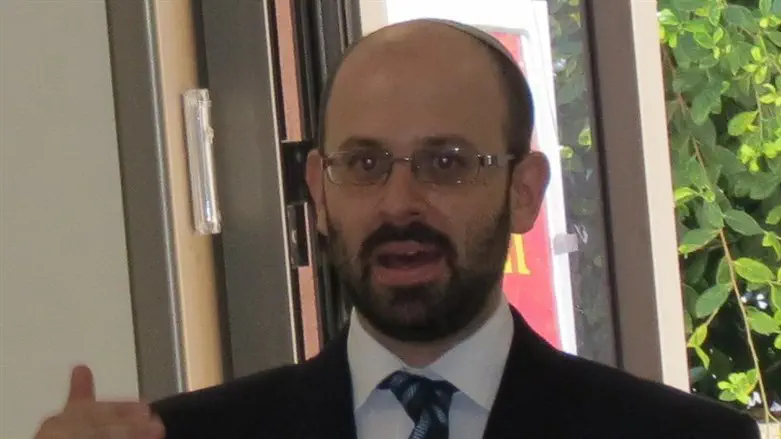
Avi Halevi Levin is an opinion columnist who writes on Israeli politics, current events, and religious-Zionist perspectives,
I remember the signing ceremony for the Oslo Accords on the White House lawn mainly because of what I was doing at the time. While television studios celebrated the occasion and leaders delivered weighty speeches, I, a nine-year-old boy, used the drawing talent I thought I had to express my opinion of the event.
I drew a cartoon showing Arafat, a weapon slung over his back, shaking Rabin's hand while planting his foot on the Land of Israel. Like many others at the time, I understood that the handshake did not mean Arafat was abandoning armed struggle. It gave him a foothold in the Land of Israel in exchange for empty promises and brought him closer to his goal of eliminating the State of Israel.
When I see Eisenkot and his partners rushing toward the formation of a government supported by the UAL and the Joint List, all the warning bells ring out again at full force. To me, it is clear that forming such a government would lead to a disaster no less severe than those that befell us following the signing of the accursed Oslo agreement.
History is repeating itself: The forces that led to Oslo are acting in the same way today and leading us toward the next disaster. I identify six parallels between the Oslo period and the current situation.
Turning a blind eye
During the Oslo period, Arafat would speak in two different languages. When speaking English, he carefully delivered conciliatory messages that would appeal to Israeli and Western audiences, but when speaking Arabic, he explained his real plan. For example, in one speech, he compared the Oslo agreement to Muhammad's Treaty of Hudaybiyyah. In other words, the entire Oslo agreement was a temporary ruse intended to build strength ahead of continuing the struggle for all of the Land of Israel.
Yigal Carmon exposed and translated Arafat's Arabic speeches in real time and passed them on to senior journalists. Those journalists, however, decided that no importance should be attached to what Arafat said in Arabic, presenting his remarks as lip service he had to pay to his extremist audience. Thus, although all the signs of deception were visible, Israel's leadership and media closed their eyes and continued walking toward the abyss.
Like Arafat in his day, the leaders of the Arab parties are making little effort to conceal their intentions or the goals they hope to achieve when the government depends on the votes of Arab Knesset members. There is open talk of abolishing the state's Jewish character, creating territorial autonomy in the Negev and Galilee, replacing the national anthem and establishing a Palestinian state along the 1967 lines. But unlike in the past, when Arafat's statements were not accessible to everyone, today, with the growth of social media, these statements are widely publicized. Nevertheless, the leaders of the left-wing bloc continue to lead the country toward disaster.
Silencing dissent
During the Oslo years, the media spoke with one voice. There were only two television channels, two radio stations broadcasting current affairs, and Yedioth Ahronoth held a monopoly in the print media. These outlets presented a uniform position supporting the accords without reservation and gave almost no platform to the other side. When fierce opposition to the accords emerged from the public, the media made sure to label opponents as extremists and cranks, thereby keeping arguments against the agreement from reaching most Israelis.
The media landscape has admittedly changed since then. Today, television channels and radio stations offer different voices, and social media is accessible to anyone. But to convince oneself that there is no danger in a government relying on supporters of terrorism, one must not only close one's eyes but also stop one's ears.
That is why efforts are being made to silence those warning against dependence on parties unwilling to acknowledge that Hamas is a terrorist organization. Any substantive criticism is immediately labeled racism, even though it is directed at elected representatives rather than Israel's Arab citizens. At the same time, efforts are being made to downplay every revelation concerning the true intentions of the Arab parties' leaders.
Extremists taking the lead
Before the 1992 election, Rabin's position was that there should be no negotiations whatsoever with the PLO, and he was elected on that basis. While he maintained an overt channel for talks with the local Arab leadership in Judea and Samaria, Yair Hirschfeld and Ron Pundak, associates of Yossi Beilin, opened a secret channel directly with senior PLO officials without Rabin's knowledge.
Only after far-reaching understandings with the PLO had already been reached did those involved present the agreement to Rabin as the only option for reaching an accord with the Palestinians. Rabin understood that rejecting the agreement that had taken shape could lead to a political showdown with Shimon Peres and Yossi Beilin and bring down his government, so he was forced to follow the extremists' lead and endorse the agreement after the fact.
Today, too, those pushing for a government dependent on the votes of the anti-Zionist Arab parties are members of the far left, some within the political system and others outside it. Apart from members of the Democrats faction, supporters of such a government include powerful business figures and influential media personalities. Their aim is to confront the Zionist left with the same dilemma Rabin faced: Either agree to a government dependent on the Arab parties' votes, or you will have no government.
The trap
In his book, "The Oslo Trap", Yuval Blumberg describes how Rabin saw that terrorism had actually intensified following the signing of the agreement. According to Blumberg, Rabin concluded from this that Arafat could not really be trusted and that the Oslo Accords would not end the conflict.
Nevertheless, Rabin was forced to continue the process for two reasons: Withdrawing would have broken up the coalition on which his government depended, and such a move would have been seen as an admission of personal failure and a retrospective vindication of the arguments made by the right and the opposition. Therefore, instead of halting the process, Rabin agreed to further concessions in subsequent agreements, in the vain hope that this would prompt Arafat to fight terrorism.
Forming a government dependent on parties that support terrorism would apparently lead to a similar scenario. By the time the leaders of the left recognize their mistake and discover the price Israel will be required to pay for establishing a government dependent on the Arab parties' votes, it could be too late.
For political reasons, and because they understand that admitting their mistake would almost certainly end their public careers, they would have no choice but to submit to more and more demands from the Knesset members on whom their government depends.
The motivation
If the danger of such moves is so clear, why does the left prefer to close its eyes, ignore the warning signs before it and enter a trap that could undermine national security?
It appears that the urge to take such a risk stems from the expectation of gaining something that the far left considers valuable and worth the risk. Regarding Oslo, Ron Pundak, one of the agreement's architects, is quoted as saying, "Oslo was not intended to bring peace; Oslo was intended to bring about the Israelization of the state instead of its Judaization."
In other words, from his perspective, the true purpose of the Oslo agreement was not the stated goal of achieving peace and quiet for future generations, but a hidden goal that he considered loftier: settling the internal political debate and bringing the faith-based right into submission to the global left.
What was a hidden goal during the Oslo period has now become a goal visible to all. Just as during Rabin's government, when the far left pushed for a dangerous agreement with a terrorist organization solely to defeat its political rivals, today it is pushing its elected representatives to endanger Israel by forming a government dependent on supporters of terrorism, under the slogan, "Anyone but Bibi."
The outcome
The results of the Oslo agreement can be debated, but it seems clear to me that, on the one hand, the faith-based public was not defeated but only grew stronger, while on the other, the agreement did not improve Israel's situation-quite the opposite.
Terrorism increased rather than diminished, and important parts of our small country are now controlled by armed enemies who continue to aspire to destroy us and are waiting only for the right opportunity to realize their vision. We have already paid for turning a blind eye to the danger with thousands of lives, and who knows whether we have finished paying that debt.
Now, too, ignoring the aspirations of the Arab parties' elected representatives and handing them the keys to the government could expose the Jewish state to terrible danger. History is repeating itself, the second time as farce, but also as a tragedy compounded many times over.