

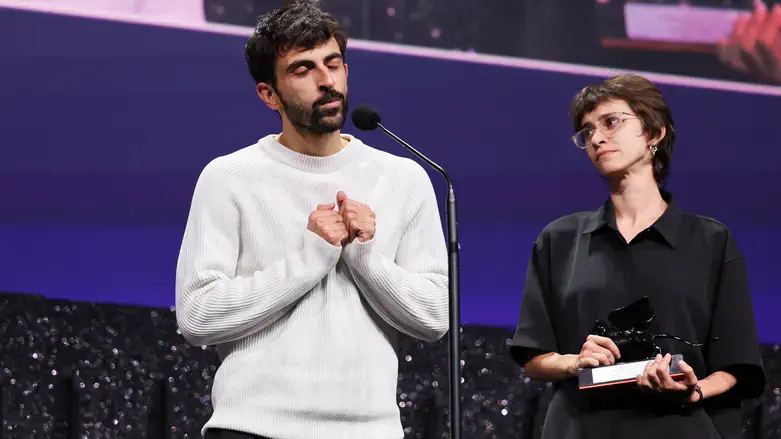
The filmmakers behind the controversial documentary NAZA are prioritizing the film's political impact and continued investigative journalism over the traditional awards-season campaign, director Yuval Abraham said during a discussion at the International Documentary Film Festival Amsterdam (IDFA).
Abraham, who joined the event remotely from London, appeared alongside producer James Wilson, known for his work on The Zone of Interest, and representatives of the film's distribution and production partners. Co-director Rachel Szor was not present.
The discussion, held at Amsterdam's DeLaMar Theater on Monday, focused on the documentary's unusual distribution strategy and its unexpected commercial success.
NAZA has attracted more than 1.5 million admissions worldwide and generated approximately $14 million in box office revenue, an extraordinary performance for a politically sensitive documentary. The film has secured theatrical distribution agreements in 56 territories through French sales agent MK2, while American distributor Neon has joined its U.S. release.
The documentary, which examines Israeli military targeting practices and civilian casualties in Gaza through interviews with Israeli military and intelligence personnel, premiered at the Venice Film Festival after being kept secret until its late addition to the competition lineup on August 24. It subsequently received the festival's Special Jury Prize and a 25-minute standing ovation.
Asked about the pressure of participating in a major awards campaign, Abraham said his attention remained elsewhere.
"We're working on the investigative journalism, and I really want to focus on that," he said.
Abraham has considerable experience with awards campaigns. Two years ago, he won the Academy Award for Best Documentary Feature for No Other Land, which he co-directed with Szor, Palestinian filmmakers Basel Adra and Hamdan Ballal.
He acknowledged that awards can increase a film's visibility but said he was more interested in direct engagement with audiences.
"I prefer to focus on doing conversations with audiences when we feel it's meaningful," Abraham said.
He added that the filmmakers hope to arrange screenings for politicians around the world and use the documentary's upcoming online release to reach Israeli and Palestinian audiences.
Variety reports that the film is scheduled to become available free of charge through The Guardian in December.
Wilson explained that the filmmakers' absence from Amsterdam was connected to their ongoing journalistic work and the continuing situation in Gaza.
"The journalism is ongoing and they are deep in that. The killing is ongoing," he said.
Wilson also argued that the film's commercial performance should encourage distributors to take risks with politically controversial material.
"It's a clarion call to distributors to not be afraid of the subject matter and to open doors to it," he said. "Because when the doors are open, people come into the cinemas to see it."
He pointed to the difficulties No Other Land encountered in securing American distribution, which ultimately forced its filmmakers to organize their own release. Abraham said that experience had taught him and Szor how difficult and time-consuming it could be to bring a documentary to a wide audience.
The film's original distribution strategy was considerably different. Fionnuala Jamison, managing director of MK2, revealed that the filmmakers initially intended to make NAZA available online through The Guardian immediately after its Venice premiere.
Following extended discussions with Wilson and MK2, they decided to prioritize theatrical distribution before making the documentary freely accessible online.
Lindsay Poulton, The Guardian's editorial director for film and television, said the project's central objective had always been its impact on audiences.
"Our north star with 'NAZA' has always been about impact. It's how you reach people, move people, and get them talking," she said.
Abraham added that the experience had taught him that making a film immediately accessible does not necessarily produce the greatest possible impact.
The production also faced considerable challenges because of the sensitivity of its subject matter. Wilson said security considerations limited the filmmakers' ability to approach potential partners and collaborators. He emphasized that the decision to keep the documentary secret until its Venice announcement was motivated by security concerns rather than a marketing strategy.
Abraham described the reaction to the film in Israel as violent, saying that while he had anticipated hostility, the consequences for the filmmakers' families had been particularly difficult. He cited right-wing protests outside Szor's parents' home.
Asked whether the documentary had changed international attitudes toward the war in Gaza, Wilson avoided making sweeping claims about its influence. He nevertheless described cinema as an antidote to fear and complicity, expressing hope that the film could contribute to broader opposition to the violence.
"I like to think 'NAZA' is a small cog in a machine of resistance," he said.
With its international theatrical distribution continuing and a free online release planned for December, the filmmakers say their priority remains bringing the documentary to audiences and encouraging further discussion rather than concentrating on the awards circuit.