

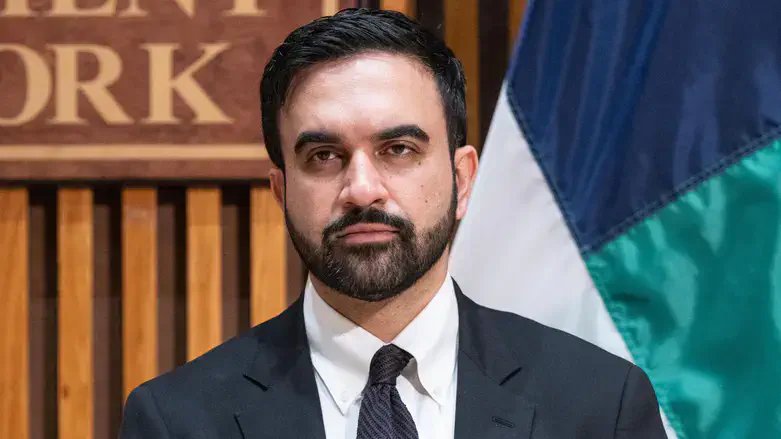
New York City Mayor Zohran Mamdani announced Monday that he is dismantling a specialized police unit responsible for counterterrorism and protest management, prompting strong criticism from Jewish leaders who warned that the decision could endanger the city's Jewish community.
The mayor said the NYPD's Strategic Response Group (SRG), established in 2015, would be disbanded and its responsibilities separated, with protest management transferred to a new civilian-led division.
“During our campaign, I promised New Yorkers that we would disband the Strategic Response Group and separate counterterrorism from protest response, and today we are delivering on that promise," Mamdani said.
“New Yorkers exercising their constitutional right to protest should not be met with the same police response as a terrorism threat," he added. “We are establishing a new, civilian-led approach that prioritizes dialogue, engagement and de-escalation."
Under the changes, a new community dialogue and de-escalation division will oversee interactions with demonstrators without carrying weapons or possessing arrest authority.
A separate NYPD First Amendment support team will include 30 uniformed officers trained in communication and de-escalation techniques.
City Hall also announced restrictions on police crowd-control methods, including prohibitions on tear gas and pepper spray during constitutionally protected demonstrations and an end to the practice of surrounding and confining groups of protesters, known as kettling.
Police officers will still be authorized to intervene and make arrests when necessary, including in cases involving civil disobedience.
NYPD Commissioner Jessica Tisch defended the restructuring, saying she would not support measures that weakened the department's ability to respond to serious threats.
“These changes will make us a stronger, more effective department," she said.
However, the announcement drew sharp objections from Jewish community representatives concerned about security at synagogues, Jewish businesses and other institutions that have faced anti-Israel demonstrations.
New York City Council member Inna Vernikov, co-chair of the council's bipartisan task force on antisemitism, told JNS that the decision would expose Jewish residents to additional dangers.
“By disbanding the SRG, Mamdani is also unleashing a monster on Jewish New Yorkers," Vernikov said.
“Our community has already endured violent protesters attacking Jewish-owned businesses, intimidating congregants at synagogues and threatening Jewish students on university campuses," she continued. “Apparently, that’s not enough."
“What’s another target painted on the backs of New York’s Jews for this mayor?" she asked.
Evan R. Bernstein, CEO of B’nai B’rith International, similarly condemned the decision, describing it as “a dangerous and ideological betrayal of public safety especially for New York’s Jewish community."
Bernstein argued that the Strategic Response Group had played an important role in responding to threatening demonstrations targeting Jewish institutions.
“At a moment when Jews remain the city’s most targeted group for hate crimes, the SRG has been one of the few specialized units capable of rapidly containing violent, antisemitic protests that have repeatedly targeted synagogues, Jewish institutions and ordinary New Yorkers," he said.
“Replacing trained officers with an unarmed, civilian ‘dialogue’ division that has no arrest powers is not reform. It is willful blindness," Bernstein added. “Dialogue does not stop mobs chanting for intifada or blocking streets outside of Jewish neighborhoods."
According to JNS, Mamdani's decision follows demands from anti-Israel activist organizations to abolish the unit. Some of those groups have organized demonstrations outside synagogues and other Jewish facilities across New York City.
Previous protests have resulted in confrontations with police, including an incident outside a Brooklyn synagogue in May that led to several arrests. An NYPD officer was also hospitalized following an attempt by anti-Israel demonstrators to remove security barriers outside Manhattan's Park East Synagogue.
The policy change comes amid persistently high levels of antisemitic hate crimes in the city.
During January, Mamdani's first month in office, reported anti-Jewish hate crimes increased by 182 percent. Since then, Jewish residents have accounted for the targets of more than half of New York City's hate crimes, despite representing approximately 10 percent of its population.
City figures showed that 57.8 percent of hate crimes recorded last month targeted Jews.
Rabbi Chaim Steinmetz of Congregation Kehilath Jeshurun, a Modern Orthodox synagogue on Manhattan's Upper East Side, told JNS that he fears the restructuring will embolden demonstrators who use protests to intimidate Jewish residents.
“At issue is not protest as free speech. That must be sacrosanct," Rabbi Steinmetz said. “What is of deep concern to the Jewish community is protest as intimidation."
He pointed to recent demonstrations outside the UJA building and Park East Synagogue as examples of protests that left Jewish residents feeling threatened.
“Zohan Mamdani is acting like the protester-in-chief, not the mayor of New York," Steinmetz said. “Because of that, there will be many more events like Park East Synagogue."
“When there is violence," he added, “it will be Mamdani’s fault."
The World Jewish Congress, however, expressed confidence that the NYPD would continue providing adequate protection despite the restructuring.
The organization told JNS that it has “every confidence" in the department's ability to safeguard Jewish residents.
“Politics must never get in the way of protecting Jewish lives," it stated.
Mamdani has long come under fire for his anti-Israel positions. During his mayoral campaign, he faced criticism over remarks he made on October 8, 2023, the day after the Hamas attack, as well as his refusal to condemn the slogan “globalize the intifada".
The controversy continued after Mamdani assumed office. On his first day as mayor, he rescinded several executive orders relating to Israel that had been enacted by his predecessor, Eric Adams.
Mamdani also became the first New York City mayor to boycott the annual Israel Day Parade.