


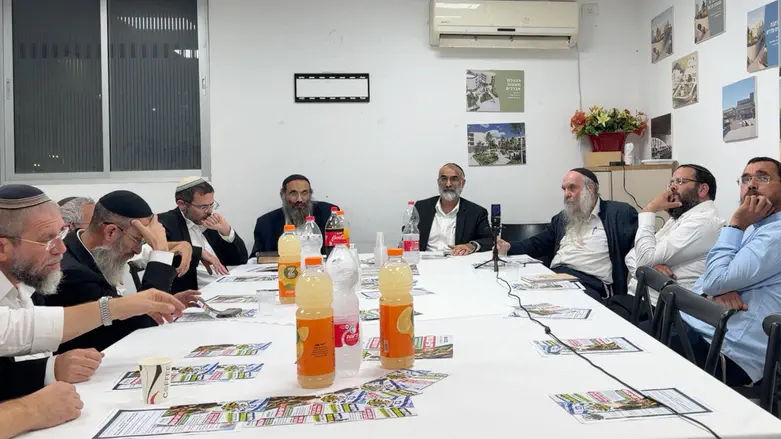
Heads of hesder yeshivas, post-high school yeshivas and pre-military academies gathered Thursday night at the hesder yeshiva in Sderot to discuss mixed-gender service in the IDF and difficulties reported by religious soldiers in observing Jewish law.
The gathering focused on a hotline recently established by the "Oz Banamer" group to provide guidance and assistance to soldiers who encounter situations during their service that pose difficulties for their observance of Jewish law.
The meeting followed a gathering of rabbis held in Jerusalem several months ago, where participants sought to explore ways to expand the initiative and foster cooperation between Torah institutions and organizations supporting religious soldiers.
Participants included Rabbi Yehoshua Shapira, Rabbi David Fendel, Rabbi David Giami, Rabbi Eliyahu Zini, Rabbi David Turgeman, Rabbi Yehuda Sadan, Rabbi Yehoshua Van Dijk, Rabbi Tzvi Kostiner, Rabbi Noam Waldman, Rabbi Moshe Chai Beharav, Rabbi Amir Maman, Rabbi Tal Shaulin, Rabbi Paniri, Rabbi Ashi Bleicher, Rabbi Moshe Shachor and Rabbi Dror Aryeh.
During the gathering, participants were presented with initial inquiries received by the campaign since the hotline opened. They discussed how to address the cases and the need to provide a broader response for soldiers.
The head of the Military Rabbinate Department, Rabbi Udi Schwartz, outlined the challenges relating to mixed-gender service in the IDF.
Rabbi Schwartz clarified that the Military Rabbinate's position is that deploying female paramedics and operational drivers under the conditions discussed is inconsistent with Jewish law and the provisions of the relevant military order. He also addressed difficulties surrounding the issue among reserve forces.
The head of the Sderot hesder yeshiva, Rabbi David Fendel, emphasized the importance of independent public initiatives, even when they do not originate within formal yeshiva frameworks.
Rabbi Fendel described past initiatives led by his students to expand Torah study among married yeshiva students. He explained that efforts not directly managed by yeshiva heads can sometimes drive significant change.
The head of the Ramat Gan yeshiva, Rabbi Yehoshua Shapira, called for additional yeshiva heads to join the initiative and for strengthening the Association of Hesder Yeshivas, with the aim of developing a common, coordinated position in dealings with the IDF.
Rabbi Dror Aryeh of the "Oz Banamer" group addressed the need for unity on the issue. He said, "This is an issue on which there is consensus, and we really need to put our heads together to work out how to address it. The most important thing is that we succeed in developing a common language, so that the IDF clearly understands which boundaries must be maintained."
Rabbi Aryeh noted that the campaign is also in contact with the Military Rabbinate. He said that, alongside raising awareness, it seeks to provide practical solutions to inquiries from soldiers.
Rabbi Eliyahu Zini called for a firm stance on the issue, arguing that the IDF must adhere to the requirements of Jewish law enshrined in military orders rather than give precedence to directives stemming from Supreme Court rulings.
During the discussion, participants emphasized that the campaign's work is undertaken with appreciation for the Military Rabbinate's work and the activities of the yeshiva associations.
Rabbi David Turgeman described accounts he had received from soldiers and officers concerning difficulties in mixed-gender service. He said a senior officer in the General Staff had expressed opposition to deploying female paramedics in armored personnel carriers with combat soldiers, describing the situation as morally harmful to both women and men.
Rabbi Yehuda Sadan emphasized that, alongside addressing difficulties relating to Jewish law, efforts must continue to reinforce recognition of the importance of IDF service, the courage of combat soldiers and their self-sacrifice.
The head of the Mitzpe Ramon yeshiva, Rabbi Tzvi Kostiner, referred to a case in which his students were sent to military prison after refusing, on religious grounds, to take part in an operation in a Namer armored personnel carrier with a female paramedic. He said the students had stood by their principles and that their position was subsequently accepted in a way that led to a positive change in the military's conduct.
Rabbi David Giami expressed support for the campaign's work and emphasized the responsibility of yeshiva heads to safeguard their students' religious way of life during military service.
Rabbi Chaimi Teitelbaum, head of the Keshet pre-military academy, presented remarks he said he had heard from senior Military Rabbinate officials describing serious problems concerning modesty. He called for determined action to enforce military directives relating to the observance of Jewish law.
Following the gathering, the "Combat Soldiers' Wives for the Sanctity of the Camp" campaign, part of the Hotam organization, issued a statement supporting the initiative while criticizing the military's conduct. The statement said, "We thank the rabbis for addressing the grave issue of harm to the sanctity of the camp in the IDF and to combat soldiers. There is currently no one in the military to turn to and no one responsible for the sanctity of the camp. This is an extremely serious situation that is causing real harm and crises."
The campaign welcomed the opening of the hotline and called on Defense Minister Israel Katz and IDF Chief of Staff Eyal Zamir to intervene. It said, "We welcome the establishment of the Oz Banamer campaign's hotline as a resource for soldiers and hope that Defense Minister Israel Katz and IDF Chief of Staff Eyal Zamir will come to their senses and address the need to rectify the situation, with an emphasis on upholding Jewish law in the IDF and preserving the military's Jewish character."