
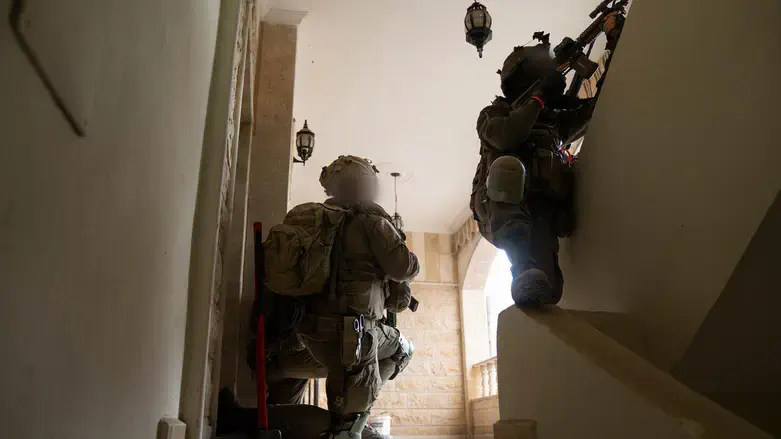
Five Givati Brigade soldiers, yeshiva students serving in the Rotem Battalion, who refused over the weekend to board a Namer armored personnel carrier carrying a female paramedic, were sentenced Sunday evening by the battalion commander to 10 days in military prison. Another 11 soldiers were sentenced to five days of confinement.
The IDF said that two of the soldiers sentenced to 10 days in prison will undergo an evaluation committee before being allowed to return to combat.
The soldiers’ punishment sparked angry reactions from political and religious figures, who accused the IDF of failing to accommodate observant soldiers and acting contrary to Jewish law.
MK Avi Maoz, chairman of the Noam party, addressed the political and defense establishment directly. “Prime Minister and Minister of Defense, this is on your watch. You are turning your back on IDF soldiers," he said. “Givati soldiers, Rotem Battalion, you risked your lives with self-sacrifice in Lebanon, and today the army is turning its back on you. It is not acceptable that with one hand the army calls on the haredim to enlist, and with the other it harms outstanding soldiers who want to live according to their faith. Even if you are required to sit in prison, do it with your head held high and Jewish pride. Free to be a Jew."
Rabbi Dror Aryeh, one of the rabbis of the Hesder yeshiva in Sderot, also condemned the decision. “This is brazen arrogance without parallel," he said. “The Minister of Defense failed to protect dedicated soldiers from progressive theatrics. The soldiers are heroes; jail will not break them. They are the pillar of fire before the camp, and they will be remembered for generations as the true victors in this bizarre story. Their commanders acted contrary to Jewish law and contrary to orders. Those who should have been tried were the commanders who violated the procedures."
The organization Wives of Soldiers for the Sanctity of the Camp called for the soldiers’ immediate release and for disciplinary action against those responsible for their treatment.
“We demand that the soldiers be released immediately and that those who mistreat them be punished. The agenda of progressive coercion has reached the lowest moral low point and resulted in extreme, violent action. The IDF is a Jewish army; Jewish law, the mitzvah and sanctity are our guiding principles. Observant Jews should not be treated like a discarded object by commanders who are not worthy of that. This is a disgrace and a badge of shame for the IDF chief of staff and the Minister of Defense."
The organization added that the treatment of religious soldiers could undermine efforts to encourage haredi enlistment. “You will not be able to talk about drafting the haredim as long as observant Jews in the IDF are being persecuted for the existence of Torah and sanctity," it said.
Earlier, Rabbi Lundin, head of the Holon yeshiva, issued a message of support to the Rotem soldiers, connecting their decision to their religious convictions and the upcoming Jewish New Year.
“Dear friends, I want to remind you now, in the month of Elul ahead of Rosh Hashanah, of the things the rabbi writes in his introduction to the cycle," Lundin said. He explained that on Rosh Hashanah, prayer should not focus primarily on a person’s individual needs, but on the revelation of God’s kingdom.
“In other words, on Rosh Hashanah, it is a good day that a person must decide with whom he works. Does he work for his own interests, or does he work for Your blessed kingdom, with the Holy One, blessed be He? And you stood precisely in that test. You are not working for the media, nor with the progressive operation, nor for all kinds of people who think that the state belongs to them. You are working for the Master of the Universe, who goes through with Israel, through what the rabbis told you, through the IDF, which is the order to remain in the camp in the humility of purity and sanctity."
“Therefore, do not be afraid and do not be dismayed," he concluded. “You did what needed to be done, and the Holy One, blessed be He, will lead the events exactly where they need to go. We are all with you, and most importantly, our Father in Heaven is with you. Wishing you success and a good year."
The incident occurred in the Rotem Battalion of the Givati Brigade while the force operating in the Gaza Strip was preparing to carry out an operational activity that included a tour using a Namer vehicle with a female medic inside.
Three soldiers refused to board the vehicle. According to sources familiar with the incident, they were subsequently asked whether another soldier in the platoon was willing to take part in the activity, but they responded that none of the other soldiers agreed to do so.
A source familiar with the details said the company commander spoke with the soldiers and explained the importance and urgency of the operational activity, but they maintained their refusal. According to the source, the brigade rabbi was also involved and approved carrying out the activity with the medic present because of its operational importance and urgency.
It was also reported that Rabbi Tzvi Kostiner, head of the yeshiva in Mitzpeh Ramon, and Rabbi Shlomo Shushan, head of the yeshiva in Beit She’an, instructed their students serving in the company not to board a combat vehicle when a medic was present.
The Association of Hesder Yeshivas expressed support for the soldiers, arguing that they had acted in accordance with the joint service order and that there was no basis for punishing soldiers who followed the arrangement.
The IDF said that under the joint service order, soldiers who maintain a religious lifestyle are entitled to carry out operational activity in a gender-segregated framework, except in unusual circumstances. The military said that in this case, the force refused to carry out the operational activity and that, as a result, the activity was canceled.