

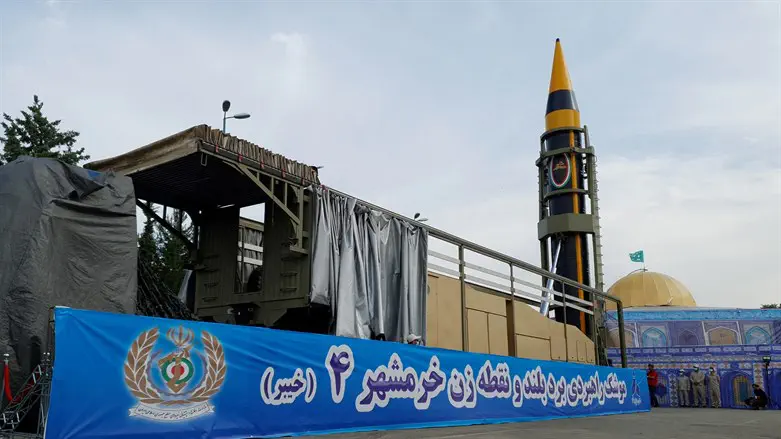
Iran is believed to retain at least 1,700 ballistic missiles and has restored enough of its weapons production infrastructure to manufacture approximately 50 additional missiles each month, despite months of American and Israeli airstrikes, Bloomberg reported Tuesday, citing a Western intelligence assessment.
The estimated production rate represents roughly half of Iran's manufacturing capacity before the war began in February, suggesting that Tehran continues to possess significant retaliatory capabilities should military hostilities resume.
The findings contrast with repeated statements by American officials since the beginning of the conflict that Iran's missile arsenal and its ability to replenish depleted stockpiles had been severely weakened.
According to a Western official who spoke to Bloomberg and cited military intelligence reports, much of Iran's conventional military infrastructure has been destroyed during the American and Israeli air campaign. Nevertheless, the Islamic Republic is believed to have preserved a substantial ballistic missile stockpile while continuing to manufacture additional weapons.
On Tuesday, Iran's Islamic Revolutionary Guard Corps (IRGC) released footage purportedly showing the unveiling of a new underground “missile city," highlighting its efforts to maintain military capabilities despite the damage inflicted during the war.
Iran may also possess thousands of Shahed-type strike weapons, according to Jim Lamson, a former CIA analyst specializing in Iran and the Middle East who currently serves as a visiting research fellow in the Department of War Studies at King's College London.
However, Lamson cautioned that determining the size of Iran's remaining arsenal is extremely difficult. Intelligence assessments are complicated by uncertainty surrounding the country's original stockpiles, the number of weapons expended or destroyed during the conflict, and the extent to which Tehran has managed to replace its losses.
He described publicly available estimates of Iran's current missile inventory as “all over the map," noting that uncertainty has increased since the war began.
The difficulty stems partly from the wide range of estimates concerning Iran's prewar arsenal and partly from the lack of reliable information about how many new missiles have been manufactured since February.
Western intelligence officials have also indicated that Russia is supplying Iran with strike weapons, although neither the quantities involved nor the specific types of weapons have been established.
Iran's Ministry of Foreign Affairs did not immediately respond to a request for comment on the intelligence assessment.