
This article is an extract from Rabbi Chaim Drukman’s book, “Step by Step," an enlightening discussion of the process of redemption that is taking place in our generation.
(Adapted and translated by Moshe Goldberg)
This is an expansion of a previous article.
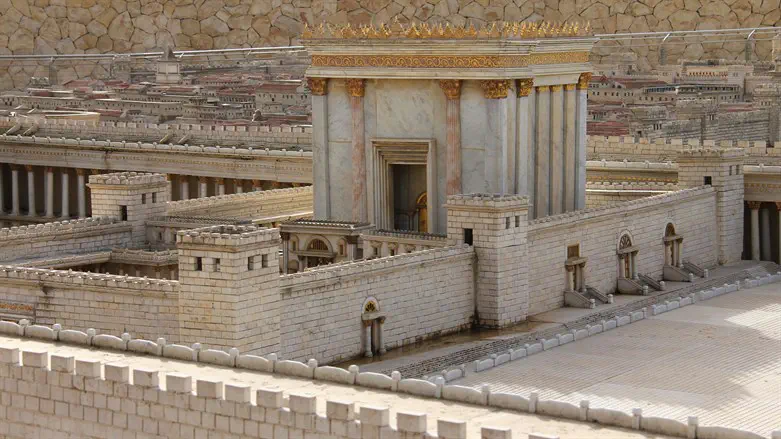
The ultimate goal of Yisrael’s Redemption is to build the Temple - the Beit Hamikdash. Just as the Jewish People remained loyal to their Land throughout history and wanted to return, so they yearned to rebuild the Temple and renew the holy service.
Now that we have been privileged to experience the establishment of the State of Israel and the wondrous phenomenon of the Ingathering of the Exiles, and after the tremendous development of our sovereign country, we might begin to feel that we have reached “the resting place and the heritage" (Devarim 12:9). We might even begin to view the Temple as unnecessary, heaven forbid.
We must renew our yearning for the Temple and the holy service, based on precedents set in earlier generations. They can teach us how vital the Beit Hamikdash is for the entire world, and especially for the Jewish People.
God created the world in order to be revealed here, a desire that can be fulfilled through the Beit Hamikdash. He chose to depend on human actions at their highest spiritual level, corresponding to the great reality when the Temple exists. Thus, as it were, God waits in anticipation for the Beit Hamikdash, and He yearns for it to be rebuilt.
Obviously, God does not need the Temple for Himself, as is written explicitly: “The heavens are My throne and the earth is the place for My foot - what house can you build for me and where will I rest?" (Yeshayahu 66:1). Shlomo said this at the Temple’s dedication ceremony: “The heavens and the upper heavens cannot contain You, as is also true for this house I built" (Melachim I 8:27). God wants the Temple to fulfill the goal of Creation - to connect heaven and earth, facilitating an encounter between mankind and God.
The Sages explain in the Midrash how Divine revelation moved further and further away from the earth because of human sins, and how it began to return as a result of the Patriarchs’ merits.
The Yearning of the Patriarchs
Avraham
The Sages describe Avraham’s yearning for the place of the Shechina, the Temple.
God’s first revelation to Avraham appears with the command, “Go for yourself from your land" (Bereishit 12:1). The Zohar explains that this command had to come first so that Avraham would cling to God properly, by going to a place where he could get closer to Him (Vol. 1, 79b).
Rabbi Yehuda Halevi writes the same idea: “Avraham could not become close to God and make a covenant with Him until after he was in the Land, at the event of the Covenant of the Pieces." (Kuzari, 2:16).
The Zohar and Rabbi Yehuda Halevi mention Eretz Yisrael, but the Temple is the highest level of the Land’s sanctity. Thus, in essence Avraham’s journey to the Land was towards the Temple. It is written, “And Avram went and journeyed to the Negev" (Bereishit 12:9). His goal was the Beit Hamikdash (Pessikta Zutreta 12:9).
The Temple is like a king’s throne. The throne and the Temple represent God’s intervention in the world. The Throne of Glory represents hidden involvement and the Temple is the revealed appearance. For Avraham, taking possession of the world is not sufficient; he demands the Temple, an intimate link to the Holy One, Blessed be He. A world without the Temple is inherently lacking.
Yitzchak
Avraham was commanded to sacrifice his son Yitzchak in the Land of Moriah. When they approached their destination, we are told, “On the third day, Avraham lifted up his eyes and saw the place from far away" (Bereishit 22:4). This was Mount Moriah, the site where the Temple was eventually built.
While God indeed commanded Avraham to go to Mount Moriah, He hid the exact location, promising to reveal it later: “Sacrifice him as an Olah on one of the mountains, which I will point out to you" (ibid. 22:2). However, nowhere is it written that God pointed out the specific mountain. How did Avraham know where to go? The Sages reply that Avraham saw a cloud covering the mountain, and he understood on his own that this was the place God had set aside (Bereishit Rabba 56:1-2). Avraham asked Yitzchak and their two companions whether they saw the same thing, but only Yitzchak said that he saw a cloud.
“And it will be, in the End of Days, the Mount of the House of God will be at the tops of the mountains and rise from the hilltops, and all the other nations will flow towards it. And many nations will go and say: “Let us rise up to God’s mountain, to the House of Yaacov’s God, and He will teach us His ways, and we will follow His paths. For Torah will emanate from Zion, and the word of God from Jerusalem." (Yeshayahu 2:3).
Yaacov
Fleeing from his brother Eisav, Yaacov stopped along the way to sleep. He dreamt about angels ascending and descending a ladder. Yaacov woke up and understood God was at that site (Bereishit 18:16). He was afraid, and he said, “How awesome this place is; it must be the House of God, and this is the gate to heaven" (ibid. 18:17).
When Yaacov woke up in the morning he built a monument at the site in God’s honor, anointed it with oil, and made a vow: If God would let him return in peace to his father’s house he would replace the monument with a Temple dedicated to God.
The Torah passage notes that this was Beit El, previously known as Luz. The Sages explain that it is a reference to Mount Moriah. Thus, Yaacov’s desire to return there and build a House of God is an expression of yearning for the Temple.
The Torah describes Yaacov’s travels in the Land. “And Yaacov travelled, and he pitched his tent beyond Midgal Eder" (Bereishit 35:21). This phrase appears in another verse in the Tanach, in a prophecy of consolation: “And you, Migdal Eder, the Ophel, the daughter of Zion, they will come to you, and the first kingdom will come, the kingdom of the daughter of Jerusalem" (Micha 4:8).
Yaacov pitched his tent beyond Midgal Eder, and this can be seen as a reference to the future Temple. On a simple level this describes Yaacov’s travels, but in depth it encompasses a much more meaningful journey - leading to the End of Days. The Temple will be at the top of the mountains, and all the nations will gather there, at the House of Yaacov’s God.
This is similar to what appears in Targum Yonatan: “And Yaacov travelled, and he pitched his tent beyond the Tower of Eder - the place where Mashiach the King will be revealed in the End of Days". Yaacov’s journey reaches far into the future, to Mashiach, reaching its zenith when all the nations gather in the Beit Hamikdash.
Micha links the Temple specifically to Yaacov: “Let us ascend to the mountain of God and to the House of Yaacov’s God." (4:2).
The Sages ask why this is so, is He not the God of Avraham and Yitzchak too? Their reply:
Even though all three Patriarchs are tightly linked to the Temple, in the future it will be named for Yaacov, because for him the Temple is a “house" - permanent and stable, lasting forever.
Moshe
After the Exodus and the splitting of the Red Sea, Moshe and the nation of Yisrael recited the epic poem Shirat Hayam, where the Temple is mentioned: “Until Your nation passes through, God, until this nation of Yours passes through. Bring them and plant them on the mountain of Your heritage, in the place You made as a dwelling, in the Temple You, God, made, with Your hands." (Shemot 15:16-17.)
Shirat Hayam was sung hundreds of years before the Beit Hamikdash was built, even long before the command to build the Tabernacle. But Moshe anticipated the glorious future. The objects of his yearning were the mountain of Your heritage and the place you made as a dwelling!
Elkanah and Channah
When they were in the desert, Am Yisrael built the Tabernacle, a temporary, portable Temple, and when they entered the Land they erected it in Shiloh. It remained there for hundreds of years until it was destroyed in the time of Eli the High Priest. Towards the end of the Tabernacle’s time in Shiloh, we are told about Elkanah, Shmuel’s father, who established a routine of visiting the Tabernacle on the holidays, year after year (Shmuel I 1:1-3).
They said: “Behold, there is a holiday of God every year in Shiloh, north of Bet El, east of the route ascending from Bet El to Shechem and south of Lebanon." (Shoftim 21:19).
The Tabernacle was at Shiloh for many years, but people did not know where it was, so much so that it was necessary to give them the precise location!
Channah, Elkanah’s wife, was also moved by her yearning for the Beit Hamikdash. This is clear from her promise: “God of Hosts, please see Your maidservant’s suffering and remember me. Do not forget Your maidservant, and give her a male child. I will give him to God for his whole life, and no razor will come upon his head." (Shmuel I 1:11).
The Holy One, Blessed be He, who knows the intentions of heart and soul, declared: “Elkanah! You moved Yisrael’s balance to the side of merit; you taught them to perform mitzvot, and many received merits because of you - I will give you a son who will add merits to Yisrael, teach them mitzvot, and cause them to receive many merits!" Thus, you see that Elkanah’s reward was Shmuel himself. (Tanna D’Bai Eliyahu Rabba 9).
Shmuel developed in the house Elkanah and Channah. From birth, he absorbed the yearning for the Beit Hamikdash. In maturity, he had the privilege of taking practical steps to build it.
King David
King David is the first one whose yearning for the Temple is explicitly noted in the Tanach:
“And it happened, when the King sat in his palace and God gave him respite from his enemies all around, the King said to the Prophet Natan: See how I sit in a house of cedars, while God’s Ark sits in a tent." (Shmuel II 7:1-2).
After David established his kingdom, he decided the time had come to build the Beit Hamikdash. He discussed the matter with Natan the Prophet, who agreed. However, soon afterwards, God sent Natan to David with a message that he would not build the Temple but his son would.
“When your days end and you come to rest with your ancestors, I will support your seed, who will come from your loins, and I will establish his kingdom. He will build a Temple for My Name, and I will establish his kingdom’s throne forever." (Shmuel II 7:12-13).
Although David understood that he would not build the Beit Hamikdash, his yearning was so great that he labored incessantly to plan for it. He commanded his son Shlomo and the leaders of Yisrael to build it after his death, established the roster of Kohanim and Leviim to serve there, found an appropriate site, and more. (See: Divrei Hayamim I, Chaps. 22-29.)
The Divine promise that David’s son would build the Temple after his death meant the construction would be delayed as long as David continued to live. The desire to build the Beit Hamikdash meant that David’s life should be shortened! We can therefore only wonder at David’s remarkable words: Shir Hama’alot - A song for rising up, by David: I was happy to hear, “Let us go to God’s House" (Tehillim 122:1).
Was David really happy to hear about a desire to go to the Temple? It would mean that the speakers wanted him to die sooner! The Sages explained: David said to the Holy One, Blessed be He: “Master of the Universe, I heard people saying, ‘When will this old man die, so his son Shlomo will build the Temple and we can do a pilgrimage on the holidays?’ And I was happy!" (Makkot 10a).
What did the rebels of the generation do? They would approach David’s window and call out, “David! David! When will the Temple be built? When can we go to God’s House?" And David said, “Even though they want to make me angry I swear that I was happy with their words!" (Talmud Yerushalmi, Shekalim 2:5).
David’s yearning was so strong that he ignored the disrespect and was happy for every expression of yearning for the Beit Hamikdash, even when the people’s intention was to mock him!
According to the Sages, David yearned for the Beit Hamikdash so intensely that it was named for him, even though he did not build it:
Shlomo built the Temple. But since David dedicated his life to building it... the Holy One, Blessed be He, did not curtail his reward but rather named it after him. As is written, “A song by David for the dedication of the Temple" (Tehillim 30:1). Did David dedicate it? Didn’t Shlomo dedicate it? However, since David dedicated his life to it, the Temple was named for him. (Tanchuma Nasso 13).
Physically, Shlomo built the Beit Hamikdash, but in the end it was destroyed. However, the link between David and the Temple remains for all eternity!
Yearning for the Beit Hamikdash Today
The Gemara tells us that many people stopped eating meat and drinking wine after the destruction of the Second Temple, as a sign of mourning for the loss of sacrifices and libations (Bava Batra 60b). Rabbi Yehoshua asked why they should not also refrain from eating bread and fruit - since the Mincha sacrifices were also stopped and no Bikurim (first fruits) were brought. In fact, he said, nobody should drink water, which is used in the special libation during Succot! However, Rabbi Yehoshua said, since we would not be able to observe such stringent prohibitions, how should we mourn the loss of the Temple?
In the end, Rabbi Yehoshua told the people that while it is impossible not to mourn at all, they should also not mourn too much. Therefore the Sages established a set of rules to show our sorrow because of the destruction and our desire to rebuild the Temple. For example, we leave an unpainted section on our walls, we put ashes on a groom’s forehead, and so on.
Yearning for the Beit Hamikdash should not be confined to mourning about past destruction; it must include preparations for the future building of the Temple. This is especially true today, as we approach the advanced stages of our Redemption.
And this is the place to quote the words of Rabbi Yehuda Halevi: “You will rise up and have mercy on Zion, for the time for favor has come, the appointed hour has arrived. Your servants cherish her stones, and they have pity on her dust." (Tehillim 102:14-15). This means that Jerusalem will indeed be rebuilt when Bnei Yisrael yearn for it as hard as can be, such that they will look favorably even on its stones and its dust. (Kuzari 5:27).
The Beit Hamikdash is not a normal building, a structure made of walls. It is where the Shechina will be revealed, “a place for Your eternal dwelling" (Melachim I 8:13). Progress in building the Beit Hamikdash depends first and foremost on enhancing our own sanctity. “I will build a dwelling place in my heart for His exalted glory" (a song sung by Rabbi Hutner zts"l, based on Sefer Chareidim).
We can conclude that enhancing sanctity within Am Yisrael is one of the most important ways to express our yearning for the Beit Hamkdash today. This will put us on a path to building the Third Temple, a permanent and eternal edifice.