
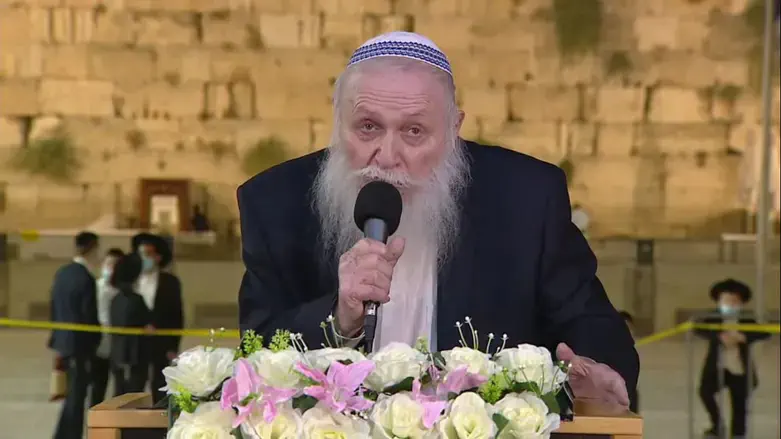
The ultimate goal of Jewish redemption is to rebuild the Beit Hamikdash, which represents the Divine Presence among the Jewish people. It emphasizes renewed yearning for the Temple, learning its laws, and increasing spiritual holiness today, preparing the nation for future redemption and the rebuilding of the Third Temple in the era of Mashiach.
This article is an extract from Rabbi Chaim Drukman’s book, “Step by Step," an enlightening discussion of the process of redemption that is taking place in our generation. (Adapted and translated by Moshe Goldberg)
Modern-Day Awakening about the Temple
We can clearly say that the ultimate goal of Yisrael’s Redemption process is to build the Temple - the Beit Hamikdash. Just as the Jewish People remained loyal to their Land throughout history and yearned to return, so they yearned for the Temple’s return and for a renewal of the holy service.
Now that we have been privileged to experience the establishment of the State of Israel and the wondrous phenomenon of the Ingathering of the Exiles, and after the tremendous development of our sovereign country, we might begin to feel that we have reached the state of “the resting place and the heritage" (Devarim 12:9). We might even begin to view the Temple as unnecessary, heaven forbid.
But this is not so! The Beit Hamikdash is the site for the practical appearance of the Shechina (Divine Presence) in our midst, the strongest possible expression of the special link between the Jewish People and our Father in Heaven. In the Temple a person achieves the closest possible approach to God - “for me, it is good to be close to God" (Tehillim 73:28).
According to the Ramban (Bamidbar 16:21), Yisrael was punished in the time of King David because they did not demand to build the Temple. When Yisrael first entered the Land in the time of Yehoshua, everybody was involved in his own personal affairs. The yearning for the Temple was neglected, until David rekindled it, made practical plans, and commanded his son Shlomo to proceed with the work. And now the time has come to renew our yearning for the Temple and the holy service. Although we cannot achieve our goal now, we must at the very least enhance our aspirations through heart-felt yearning. We must yearn for the Temple’s renewal, and avoid our ancestors’ mistakes as described by the Ramban, heaven forbid.
The yearning for the Temple began at the time of Creation and continued throughout all the generations, with the goal of reaching the time of the Mashiach and the End of Days. Then, all the yearning will be completely fulfilled. As is written:
And it will be, in the End of Days, The Mount of the House of God will be at the tops of the mountains and rise from the hilltops, and all the other nations will flow towards it. And many nations will go and say: “Let us rise up to God’s mountain, to the House of the God of Yaacov, And He will teach us His ways, and we will follow His paths." For Torah will emanate from Zion, And the word of God from Jerusalem. (Yeshayahu 2:2-3).
The Plan of Creation
Why do we care about the Temple? Why is it so important and precious?
The Gemara teaches us, “Seven items were created before the world" (Pesachim 54a; Nedarim 39b). It first lists three pairs: (1) Torah and Repentance; (2) The Garden of Eden and Gehenom; and (3) The Throne of Glory and the Temple. The seventh item is Mashiach’s name. It is clear that the seven items were not physically created before the world, but rather that their essence was established before Creation, since they encompass the entire plan of Creation and its goals. The purpose of the Creation was so that His will would be revealed in the world. The Torah shows how to reveal God’s will a priori within Creation, while Repentance guides us in mending possible faults and returning nature to its proper goals.
God created the world with the intention of being revealed, providing Divine guidance, and establishing contact with His creatures. The Throne of Glory represents God’s hidden intervention in nature, like a king sitting behind the scenes in his palace, while he continues to manage the affairs of state. However, God wants to maintain more open contacts with His creations, like a king who mingles with his citizens.
And that is the goal of the Temple - to be a place for inspiration through the Shechina, a place through which the creations can approach the King of the Universe and be sanctified by His light, as is written, Let them make a Temple for me, and I will dwell within them (Shemot 25:8). What is written is not “within it" but rather “within them." God will be revealed in Yisrael and in the entire world through the Beit Hamikdash.
Thus, the Temple is an expression of the objective of Creation as a whole: Divine revelation in a living, authentic fashion, forming a link between Creation and Creator. Through the Temple, Creation as a whole becomes a “House of God." The way to achieve the Temple’s full reality is through “Mashiach’s name." A name is a way of being revealed. Thus, Mashiach’s name means achieving full Redemption through Mashiach’s appearance in the world.
The House of our Life
The Sages see the verse, Your neck is like David’s tower, built as an ornament (Shir Hashirim 4:4), as a reference to the Beit Hamikdash. They explain the comparison to a neck in various ways. For example: Just as a person cannot go on living if he has no neck - so, when the Temple was destroyed, there is no life left for Yisrael. (Shir Hashirim Rabba 4:6).
Rav Kook discusses the great gap between us, the Temple, and the holy service:
"When the Temple stands, His sons have knowledge of God, And His chosen ones are prophets of truth and justice - through whom God’s spirit speaks, from whose tongues His word is heard. The abundance of Ruach Hakodesh and a flame of love by the Exalted God, the God of Yisrael, lights up the heart of the Jewish People, bringing warmth of the light of the sacrifices to its entire spirit. Then, the sanctity and the Temple, and the full holy and wonderful service - 'Kohanim performing their labor, Leviim at their stand, and Yisrael at their position' - highlight strong and brave waves of life, the beautiful internal life of the Jewish People. Their soul clings to their God, and to their noble love and holy link to His service, with all the warmth of life and emotions of the heart, the soul, and the spirit, and all the myriad internal and external feelings." (Olat Re’iyah vol. 1 pp. 117-118).
"The link to God is alive, filled with strong emotions and life’s power; it goes beyond being logical and analytical. But this living connection can only fully exist in a perfect reality - when the Beit Hamikdash stands in its rightful place, with all that entails."
Rav Kook continues:
"However, after the terrible destruction we experienced, after the Temple of our desires was burned, and our House of Life lost its honor, after our bones were dispersed to the mouth of hell, and the voice of inner life, strong and brave with the Divine power of the God of strength for all eternity, was silenced and humiliated - We cannot imagine the greatness and the power, the grandeur and the purity, of the tasks of tremendous life - pure and holy, buoyed up by holy strength - of the holy rituals in the Beit Hamikdash.
"Today we cannot understand the true meaning of the Beit Hamikdash. We cannot picture the significance of its holy rituals. When the Temple existed and the service took place as it should - it represented the deep and living link between the Jewish People and the Holy One, Blessed be He. But now all of that has been destroyed, and we are not even able to imagine it.
"Even so, Rav Kook writes: In any case, all the logic of our spirit and the position of our souls are based on and continue to exist as a result of that original light, shining from the very beginning, in primordial times.
"Even though we cannot really understand the true value of these elements, what exists in our souls is a remnant of that long-lost light in the Beit Hamikdash. Even today, our souls are influenced by the exalted light from thousands of years ago." And Rav Kook ends: "Until the day comes when Yisrael will be lifted up and carried high, returning to its tent as in the beginning, with the original splendor and glory."
Yearning for the Beit Hamikdash Today
In 1967, the day after Jerusalem was liberated, I heard from my mentor, the illustrious “Nazir" (Rabbi David Cohen), about an emotional meeting he had with Rabbi Yisrael Meir Hakohen of Radin, the Chafetz Chaim. It took place in 1913, a year before the First World War began. He told us the story and later published it in a pamphlet:
In the evening, I went to see the Chafetz Chaim, and he began to talk to me at length about our priestly families, and the many rabbis and Torah giants among them. (Both the Chafetz Chaim and the Nazir were Kohanim.) He said, “At first, when I used to pray, ‘Return to Your city Jerusalem, with mercy,’ I would think to myself, this is prayer, merely prayer... And when I would say, ‘Advance the flowering of the seed of David,’ I would think, this is prayer, merely prayer... But now, when I recite these prayers, I think: Here it is, ever so slowly, here it comes - now, now, soon, soon!"
And he said, “I do not know if it will happen in my life, I am quite old. But in your lifetime - for sure, absolutely, for sure!" And then he added: “Behold, the Beit Hamikdash will be built and the service will resume and there will be many halakhic questions about sacrifices. Who will you ask; will it be the rabbis? They all studied the Shulchan Aruch, Yoreh Dei’ah, Choshen Mishpat, Orach Chaim - but not the laws of sacrifices! It is up to us, the Kohanim, to prepare ourselves and study these laws!"
The Chafetz Chaim saw the approaching Redemption, and he gave instructions to prepare for it properly by studying the laws of sacrifices and the Temple rituals.
The Beit Hamikdash is not simply a building, a structure made of walls. It is where the Shechina will be revealed, a place for Your eternal dwelling (Melachim I 8:13). Progress in building the Beit Hamikdash depends first and foremost on enhancing our own sanctity. And this is one of the most important ways to express our yearning for the Beit Hamikdash today. It will put us on a path to building the Third Temple, an edifice that will last for all eternity.