


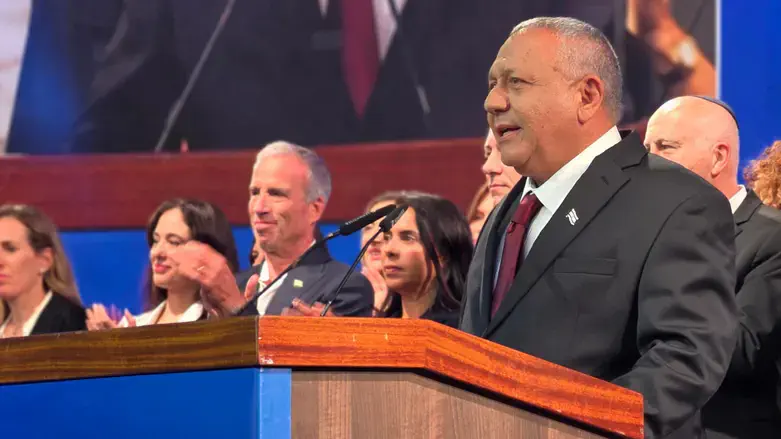
Yashar party chairman Gadi Eisenkot delivered a speech early Wednesday morning at his party's headquarters in Tel Aviv following the release of the exit polls in Israel's 26th Knesset elections.
Eisenkot declared that his party had achieved a historic result, argued that the public had expressed a lack of confidence in Prime Minister Benjamin Netanyahu, and called on him to retire from politics.
"We made history! The public has voted for change. The coalition responsible for the failures has lost the people's trust. The Israeli public voted against Netanyahu continuing to serve as Prime Minister of Israel," Eisenkot declared.
According to Eisenkot, the exit polls indicated growing support for the political camp seeking to replace the current government, although the official results had yet to be determined and it remained unclear who would be able to form the next government.
"Tonight, Netanyahu finds himself facing a larger and stronger Zionist, statesmanlike majority. A worthy leader would accept the people's vote of no confidence and announce his retirement from politics today," he said.
Eisenkot addressed the possibility that the narrow margins between the political blocs could lead to a political deadlock and another election, stressing his determination to prevent such an outcome.
"With such high voter turnout in these elections, it would be a mistake to hold another election. It is our duty, and my personal duty, to do everything possible to respect the will of the people," he said.
He argued that Israelis wanted to put an end to the political culture of the current government and establish a government that would work to heal divisions within Israeli society.
"Millions of Israelis have had enough of the culture of lies, enough of the failures, enough of the division and incitement. Tonight marks the beginning of a journey that must culminate in the establishment of a Zionist government."
Eisenkot pledged to work with his political partners to establish a stable government that would represent all Israeli citizens, not only those who voted for his party.
During his speech, Eisenkot reiterated the four principles he had presented throughout the election campaign as conditions for forming the next government.
He said the next government must be committed to recognizing Israel as a Jewish and democratic state, upholding the values of the Declaration of Independence, passing legislation requiring national service for all, and dismantling Hamas.
"This will be a government that upholds the principles I have presented throughout this journey: recognition of the State of Israel as a Jewish and democratic state, commitment to the values of the Declaration of Independence, commitment to passing a law requiring service for all, and commitment to dismantling Hamas," he stated.
Eisenkot then addressed the heads of Israel's defense establishment and senior civil servants directly, urging them to continue carrying out their duties in a professional, nonpartisan manner during the interim period before a new government is formed.
"I am addressing the heads of the defense establishment and the civil service: Netanyahu is a caretaker prime minister, without a mandate or public trust. Remember that you serve the state and the interests of Israel's citizens alone," he said.
Eisenkot pledged to support senior officials if they came under political pressure and issued a direct warning to the prime minister.
"Netanyahu, don't you dare use Israel's security for your political purposes."
Toward the end of his speech, Eisenkot sought to portray his party's achievement not as a victory for one political camp over another, but as an opportunity for broader change in Israeli society.
"The era of draft evasion, failures, and lies is over. The era of 'us' and 'them' is over. We will prove that this is not a victory of one side over another among our people, but a victory for the entire people of Israel," he said.
He concluded with a message of hope and unity, pledging to work toward establishing a government that would usher in what he described as a new era of mutual responsibility and solidarity.
"Israel is on its way to a new era. An era of hope, mutual responsibility, and solidarity."